

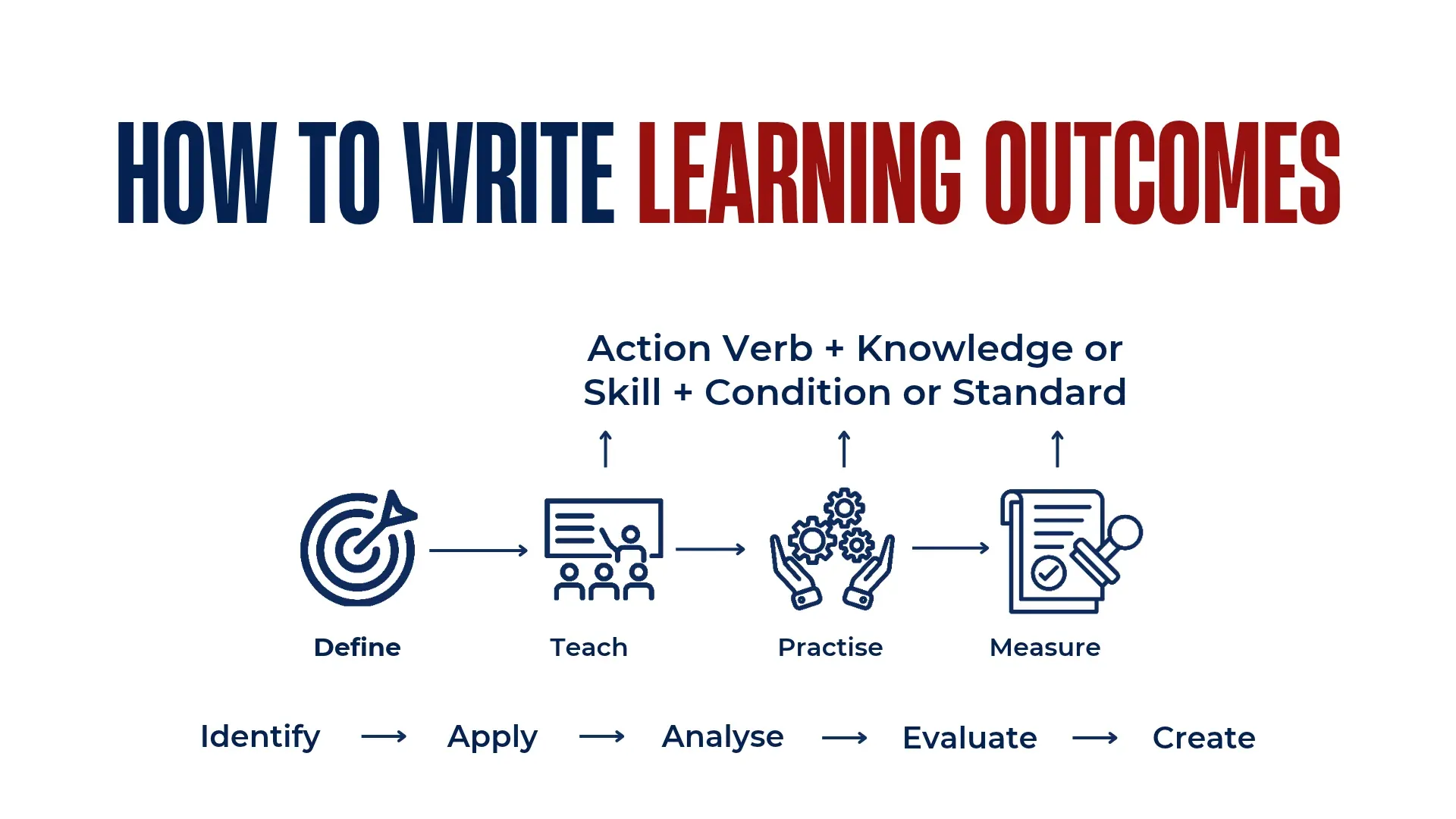
Learning outcomes explain what participants should know or be able to do after completing a course. This guide shows training providers how to write clear, measurable outcomes, select suitable action verbs and connect each outcome to course content and assessment.
What Are Learning Outcomes?
Learning outcomes are clear statements describing what a learner should know, understand or be able to demonstrate after completing a learning activity. They define the intended result of the learning rather than listing what a trainer plans to teach.
A course outline may say that the programme covers workplace risk, incident reporting and emergency procedures. Those are topics. Course learning outcomes go further by explaining what learners should be able to do with that information.
For example:
“By the end of the course, learners will be able to identify three common workplace hazards and select an appropriate control measure for each one.”
This statement describes an observable result. It gives the provider a clearer basis for choosing content, designing activities and deciding how learning will be checked.
Learning outcomes can be used for classroom courses, online programmes, webinars, workshops, conferences and blended learning. Their depth should reflect the duration, intended audience and purpose of the activity.
Learning outcomes describe the expected result of a course from the learner’s perspective, not merely the subjects included in the programme.
Why Learning Outcomes Matter
Effective learning outcomes create a connection between what a course promises, what it teaches and what learners are expected to achieve. Without this connection, a course can contain useful information while still lacking a defined purpose.
For learners, outcomes clarify what they can reasonably expect to gain. For trainers, they help determine what must be taught and which activities deserve the most time. For course designers, they provide a basis for selecting materials and assessment methods.
Learning outcomes are also important when a provider wants to evaluate or independently accredit a course. A reviewer needs to determine whether the materials support the stated outcomes and whether any assessment provides suitable evidence of achievement.
If a course claims that learners will demonstrate a practical technique, the programme must provide an opportunity to learn and practise that technique. A knowledge-only quiz may not be sufficient evidence of practical performance.
Clear outcomes also prevent exaggerated marketing claims. A two-hour introductory session may help learners identify or explain a process, but it is unlikely to establish complete professional competence in a complex occupation.
Learning Objectives and Outcomes: What Is the Difference?
Learning objectives and outcomes are sometimes used interchangeably, and organisations may define them differently. A useful distinction is that an objective describes the intended direction of teaching, while an outcome describes what the learner should be able to demonstrate after learning.
An objective might state:
“The course aims to introduce participants to the principles of data protection.”
A corresponding outcome could state:
“By the end of the course, learners will be able to identify the lawful basis used in three common workplace data-processing scenarios.”
The objective explains the provider’s intention. The outcome makes the expected learner achievement more visible and measurable.
This distinction does not require providers to maintain two complicated sets of statements. For a short training course, a clear purpose followed by several measurable outcomes will usually be more useful than repeating almost identical objectives and outcomes.
How to Write Learning Outcomes
The simplest method is to build each outcome from four possible components:
Learner + observable action + subject or task + condition or standard
A complete statement might read:
“By the end of this workshop, learners will be able to complete an incident report using the organisation’s required reporting fields.”
Here, “learners” identifies who will perform the action. “Complete” is the observable verb. “An incident report” is the task, and “using the organisation’s required reporting fields” provides the relevant condition.
Not every learning outcome needs an elaborate condition or numerical standard. The additional detail should make the outcome clearer, not turn it into a paragraph.
Step 1: Identify the course purpose
Before writing learning outcomes, define why the course exists and who needs it. Consider what problem the learning is expected to address and what participants should be able to do differently afterwards.
A new-manager course, for example, could cover communication, delegation, feedback, performance management and employment responsibilities. Trying to address all of these in a short session would produce broad outcomes that the course could not properly support.
A more focused purpose could be:
“To help first-time managers prepare for and conduct constructive employee feedback conversations.”
This purpose provides a realistic basis for selecting outcomes.
Step 2: Determine the learner’s starting point
Learning outcomes should account for what participants are expected to know before the course. An introductory programme and an advanced professional workshop should not promise the same level of achievement.
Where starting knowledge matters, state it through the intended audience or entry requirements. An advanced outcome may be appropriate when learners already possess the foundation needed to achieve it.
This distinction is especially important for technical and safety-sensitive subjects. A short CPD activity may update an established practitioner’s knowledge without being sufficient to train a beginner for independent practice.
Step 3: Decide what learners should achieve
Separate essential outcomes from interesting content. Ask what a successful learner must be able to demonstrate when the activity ends.
The answer may involve knowledge, practical application, analysis, professional judgement, communication or reflection. Select only the most important results that the available learning time can genuinely support.
If a one-hour webinar has twelve substantial outcomes, it is worth checking whether those statements are really topics rather than achievable results.
Step 4: Choose an observable action verb
Begin each outcome with a verb that shows how learning could be demonstrated. Useful learning outcomes verbs include identify, describe, explain, calculate, apply, compare, analyse, evaluate, design and demonstrate.
Avoid relying on vague verbs such as know, learn, appreciate, become familiar with or understand. These words describe internal mental states that cannot be observed directly.
“Understand workplace risk” does not explain how understanding will be shown. Depending on the course level, it could be rewritten as:
“Identify common sources of workplace risk.”
“Explain how likelihood and severity affect a risk rating.”
“Apply a risk-assessment process to a workplace scenario.”
“Evaluate whether the proposed controls reduce the identified risk.”
Each version represents a different type and depth of learning.
The Quality Assurance Agency advises using active, assessable verbs and avoiding vague wording such as “be aware of” or “be familiar with.” Its guidance also stresses checking whether an outcome can be directly assessed through an appropriate method. Quality Assurance Agency
Step 5: State the relevant knowledge or performance
The verb alone is not enough. Explain what the learner will identify, calculate, produce or demonstrate.
“Learners will be able to analyse information” is measurable in theory but too general to guide course design. A more useful version would be:
“Learners will be able to analyse monthly sales data to identify two causes of declining customer retention.”
The subject or task should be precise enough to communicate the intended achievement without unnecessarily restricting how it can be demonstrated.
Step 6: Add a condition or standard when it adds value
Some outcomes need to explain the circumstances in which the action will occur or the standard expected.
Examples include:
“Using a supplied case study, learners will be able to distinguish personal data from special-category data.”
“Learners will be able to perform the equipment shutdown procedure in the correct sequence without omitting a safety-critical step.”
“Learners will be able to draft a project objective that includes a defined result and completion date.”
Conditions are particularly useful for practical performance, calculation, compliance and scenario-based judgement. They can also help distinguish introductory recognition from independent performance.
Avoid inserting arbitrary numbers merely to make an outcome appear measurable. Requiring learners to “list five benefits” is only useful when five benefits have educational or professional significance.
Step 7: Check that the outcome is achievable
An outcome must be realistic within the course’s duration, delivery method and learner starting point.
A short introductory course may enable participants to describe a process or apply it to a guided example. It should not claim to create professional competence where competence requires extensive practice, supervised experience or workplace assessment.
Check whether learners receive enough explanation, examples, practice and feedback to reach the stated level. If an outcome requires analysis but the course only presents facts, either the learning activity or the outcome needs revision.
Step 8: Match the outcome to course content
Every stated outcome should be visibly supported by the learning materials. If learners are expected to calculate a result, the course must teach the calculation and provide an opportunity to use it.
A simple course-design check is to take each outcome and locate:
- the content that teaches it;
- the activity that helps learners practise it;
- the assessment or completion evidence that checks it.
If any part is missing, the course is not fully aligned. Either additional learning must be added or the outcome must be adjusted.
Step 9: Select an appropriate way to measure it
The assessment method should test the action described by the outcome. A multiple-choice question may be appropriate for identifying a requirement or selecting the correct response. It is less suitable for demonstrating physical performance, producing a professional document or conducting a conversation.
UCL’s course-design guidance explains that learning activities and assessments should target the same level of proficiency expressed in the outcome. If learners are expected to evaluate something, they need learning activities and an assessment that allow them to practise and demonstrate evaluation. UCL
Not every CPD activity needs a formal examination. Achievement may be explored through a scenario, discussion, written exercise, reflective task, demonstration, observed practice or workplace activity. The method should fit the claim being made.
Step 10: Edit for clarity
A final outcome should normally express one main achievement. Multiple verbs can hide several separate expectations in one sentence.
For example:
“Learners will identify hazards, evaluate risks, select controls and create a complete workplace risk assessment.”
This may represent four outcomes rather than one. Separating them makes it easier to design the course and determine whether each result has been achieved.
Read every outcome from the learner’s perspective. It should use plain language, avoid unnecessary jargon and make sense before the person takes the course.
A Practical Learning Outcome Formula
A reliable starting formula is:
By the end of this course, learners will be able to + action verb + relevant knowledge or task + condition or standard where needed.
For example:
“By the end of this course, learners will be able to explain the difference between active learning time and total course duration.”
“By the end of this workshop, learners will be able to apply the complaints procedure to a supplied customer-service scenario.”
“By the end of this practical session, learners will be able to inspect the equipment and record defects using the approved checklist.”
The formula provides consistency, but it should not make every outcome sound mechanical. Providers may shorten the repeated opening by introducing a list with “By the end of the course, learners will be able to:” and then writing each outcome as a complete action statement.
Using Bloom’s Taxonomy for Learning Outcomes
Bloom’s Taxonomy is a framework commonly used to organise cognitive learning by increasing levels of complexity. The revised version is often presented through six categories: remember, understand, apply, analyse, evaluate and create.
It can help course designers choose a learning outcomes verb that reflects the intended level. However, Bloom’s Taxonomy should be used as a design aid rather than a substitute for professional judgement.
Remember
At this level, learners retrieve or recognise information. Suitable verbs include define, identify, list, name, recall, recognise and state.
Example:
“Identify the information that must be included in a completion certificate.”
Understand
Learners explain an idea or interpret information. Suitable verbs include classify, describe, discuss, explain, interpret, summarise and distinguish.
Example:
“Explain why course duration and active learning time may be different.”
Although “understand” is the category name, it is usually better to use a verb that shows how understanding will be demonstrated.
Apply
Learners use knowledge in a relevant situation. Suitable verbs include apply, calculate, carry out, complete, demonstrate, implement, operate and use.
Example:
“Apply the organisation’s document-control procedure when updating course materials.”
Analyse
Learners examine information, recognise relationships or separate something into meaningful parts. Suitable verbs include analyse, categorise, compare, contrast, differentiate, examine and investigate.
Example:
“Compare two learner records and identify gaps in the completion evidence.”
Evaluate
Learners make a reasoned judgement against evidence or criteria. Suitable verbs include assess, critique, evaluate, justify, prioritise, recommend and review.
Example:
“Evaluate whether a proposed assessment method provides suitable evidence for each learning outcome.”
Create
Learners combine knowledge or skills to produce something new. Suitable verbs include construct, create, design, develop, formulate, plan and produce.
Example:
“Design a course review process that assigns responsibility, evidence and review dates.”
Higher levels are not automatically better. A short compliance update may reasonably focus on identifying new requirements, while an advanced professional programme may require analysis or evaluation. The chosen level should suit the audience, learning need and time available.
UCL notes that Bloom’s Taxonomy can help course designers use specific active verbs and communicate the expected level of achievement. UCL guidance on writing short-course outcomes
Learning Outcomes Examples for Training Courses
The following examples show how broad statements can be converted into clearer training learning outcomes.
Data protection training
Too vague:
“Understand data protection.”
Improved:
“Identify whether personal information in five workplace examples requires additional handling controls.”
For a more advanced course:
“Evaluate a proposed data-retention schedule against the organisation’s documented requirements.”
Leadership training
Too vague:
“Learn about leadership skills.”
Improved:
“Use a structured feedback model to prepare for a performance conversation.”
For an advanced programme:
“Evaluate two leadership responses to a workplace conflict and justify the most appropriate approach.”
Health and safety training
Too vague:
“Know how to assess risks.”
Improved:
“Identify workplace hazards and select a suitable control measure for each one.”
Where practical performance is taught:
“Complete a workplace risk assessment using the organisation’s approved documentation.”
Customer-service training
Too vague:
“Become familiar with complaint handling.”
Improved:
“Apply the organisation’s complaint-handling process to a dissatisfied-customer scenario.”
Another suitable outcome might be:
“Record a complaint using all mandatory information fields.”
Train-the-trainer course
Too vague:
“Understand course planning.”
Improved:
“Write three measurable learning outcomes for a short workplace course.”
A higher-level outcome could state:
“Evaluate whether course content and assessment methods are aligned with the stated learning outcomes.”
Cybersecurity awareness
Too vague:
“Learn about phishing.”
Improved:
“Identify common indicators of phishing in a selection of workplace messages.”
The course might also include:
“Select the correct reporting action after identifying a suspected phishing attempt.”
Practical equipment training
Too vague:
“Understand how to operate the equipment safely.”
Improved:
“Complete the pre-use inspection without omitting a safety-critical check.”
If the course includes observed performance:
“Demonstrate the equipment shutdown procedure in the correct sequence.”
The assessment for this outcome should include observation of performance rather than relying exclusively on a written quiz.
How Many Learning Outcomes Should a Course Have?
There is no universal number. The right quantity depends on the course duration, depth and complexity.
A short webinar may have two or three focused outcomes. A full-day course may need several more, while a longer programme may include overarching course learning outcomes supported by outcomes for individual modules.
The main test is whether every outcome is important, achievable and adequately supported. A long list can dilute the course’s purpose and create expectations that cannot be measured.
Providers should also avoid writing an outcome for every minor fact. Learning outcomes should communicate the significant results of participation, not reproduce the course contents page.
How to Measure Learning Outcomes
Measuring learning outcomes means obtaining appropriate evidence that learners can perform the stated action. The method must correspond to the verb and the required level.
An outcome using “identify” might be checked through selected-response questions, classification or an annotated example. “Explain” may require a short written or spoken response. “Apply” normally needs a scenario, exercise or practical task. “Demonstrate” usually requires observed performance. “Evaluate” requires the learner to make and justify a judgement against suitable criteria.
A useful measurement process asks four questions:
- What evidence would show that the learner achieved this outcome?
- Does the course give learners an opportunity to practise it?
- Does the assessment require the same type of performance?
- Are the success criteria clear and applied consistently?
Completion and achievement should not be confused. Attendance can show that someone was present, while an assessment may provide evidence of learning. Where a course has no assessment, providers should avoid implying that individual achievement has been formally verified.
For broader evaluation, aggregated assessment results can reveal how well the course supports its outcomes. If many learners fail the same question or task, the provider should investigate the outcome, course content, instructions and assessment rather than assuming the learners are solely responsible.
Mapping Outcomes to Content and Assessment
Learning-outcome mapping helps providers demonstrate that every outcome is supported and, where applicable, measured.
A mapping record can be kept without a complicated table. For each outcome, record:
Outcome 1: What learners are expected to achieve.
Teaching evidence: The module, slide, video, activity or reading that supports the outcome.
Practice opportunity: The scenario, discussion, exercise or demonstration through which learners apply the learning.
Assessment evidence: The question, task, observation or other method used to check achievement.
Completion requirement: The result or participation requirement the learner must meet.
For example, an outcome requiring learners to “apply a risk-rating method” might be supported by an explanation and worked example, practised through a guided scenario and assessed through a new case study.
This approach makes gaps visible. If an outcome has no related teaching evidence, the course cannot reasonably expect learners to achieve it. If it has no suitable measurement, the provider cannot confidently claim that achievement has been assessed.
QAA guidance emphasises making the relationship between outcomes, assessment and programme goals clear to learners. QAA Quality Code guidance
Common Mistakes When Writing Learning Outcomes
One of the most common mistakes is using words such as know, learn or understand without explaining how that learning will be demonstrated. Replacing the word with an action verb usually makes the intended result clearer.
Another is writing outcomes around trainer activity. “The trainer will cover safeguarding responsibilities” describes delivery, not learner achievement. A learner-focused version could state: “Learners will be able to explain their responsibility for reporting a safeguarding concern.”
Some outcomes contain several different skills. Combining identification, analysis, practical performance and evaluation in one sentence makes the result difficult to teach and measure. Separate outcomes are usually clearer when the actions require different evidence.
Overpromising is another risk. Words such as master, become competent or perform independently should be used only where the learning, practice and assessment justify them.
Providers also sometimes select impressive higher-order verbs without designing learning at the corresponding level. An outcome that says “evaluate” is not supported by a course that only asks learners to recall definitions.
Finally, learning outcomes can become detached from the course after materials are updated. Outcomes, content, assessments and marketing descriptions should be reviewed together whenever a material change is made.
Learning Outcomes for Different Delivery Formats
The principles remain the same across classroom, online and blended learning, but the available evidence may differ.
In a live classroom course, learners may demonstrate outcomes through discussion, exercises, presentations or observed practice. The provider should ensure that participation opportunities are realistic for the class size.
A live webinar may support identification, explanation and scenario-based application. Claims of individual practical competence would normally require additional evidence beyond passive attendance.
Self-paced online courses can use branching scenarios, written tasks, quizzes and digital exercises. Providers should check that automated questions genuinely match the outcomes rather than testing only superficial recall.
Blended learning may use online study for foundational knowledge and a live session for practical application. The outcomes should make clear how the different components contribute to the overall result.
Learning Outcomes and CPD Course Accreditation
Learning outcomes are an important part of an evidence-based CPD course review. They help define the scope of the course and provide a basis for examining its materials, learning time and completion arrangements.
During the CPD Qualifications review process, each stated outcome may be traced through the teaching material, assessment evidence and completion requirement. An outcome claiming practical demonstration, for example, should be supported by a suitable practical learning and assessment method.
Providers applying for CPD course accreditation should submit the actual learning materials rather than relying only on a course outline or marketing page. The published CPD evidence requirements explain the course specification, learning materials, assessment evidence and supporting records that may be needed.
Learning outcomes should not make claims beyond the course’s evidence. CPD accreditation recognises a professional learning activity; it does not by itself turn the activity into a regulated qualification, confer a professional licence or establish occupational competence.
A Final Checklist for Effective Learning Outcomes
Before approving a learning outcome, ask:
- Is it written from the learner’s perspective?
- Does it contain a clear action verb?
- Does it describe one main achievement?
- Is the expected knowledge or performance specific?
- Is it realistic for the audience and learning time?
- Do the course materials teach it?
- Can learners practise it?
- Is there a suitable way to demonstrate or measure it?
- Does the wording avoid unsupported claims of competence?
- Is it consistent with the course description and certificate?
If an outcome cannot pass these checks, revise the wording or reconsider the course design before publication.
Summary
Writing learning outcomes begins with defining the course purpose and identifying what learners should be able to demonstrate afterwards. Each outcome should use a clear action verb, describe the relevant knowledge or performance and include a condition or standard when that detail improves clarity.
Bloom’s Taxonomy can help providers choose verbs at an appropriate level, from identifying and explaining to applying, analysing, evaluating and creating. The selected verb must match the course content, learning activities and assessment.
The strongest outcomes form a clear evidence chain: the course teaches the outcome, learners have an opportunity to practise it and an appropriate activity measures it. Outcomes should also remain proportionate. A short course should not claim to create professional competence unless its depth, practical experience and assessment genuinely support that claim.
Frequently asked questions
How do you write a learning outcome?
State what the learner will be able to do after completing the course. Use one observable action verb, identify the relevant subject or task and add a condition or standard where necessary. For example: “By the end of the course, learners will be able to apply the reporting procedure to a workplace incident scenario.”
What is an example of a good learning outcome?
“By the end of the workshop, learners will be able to write three measurable learning outcomes for a short training course.” It identifies the learner’s action, the expected product and a clear scope.
What are measurable learning outcomes?
Measurable learning outcomes describe actions that can be observed or evidenced, such as identifying, explaining, calculating, applying, comparing, evaluating or demonstrating. They avoid relying only on vague words such as know or understand.
What verbs should be used for learning outcomes?
Suitable verbs include identify, describe, explain, calculate, apply, demonstrate, compare, analyse, evaluate, justify, design and produce. The best verb depends on the required level and the evidence learners will provide.
Should “understand” be used in a learning outcome?
It is usually better to explain how understanding will be demonstrated. Depending on the intended level, “understand” could be replaced with identify, explain, apply, compare or evaluate.
What is the difference between learning objectives and outcomes?
An objective generally describes the intended direction or purpose of teaching. A learning outcome describes what the learner should be able to demonstrate after completing the learning activity.
How many learning outcomes should a course have?
There is no fixed number. A short webinar may need only two or three, while a longer programme may require more. Every outcome should be important, achievable and supported by sufficient learning and suitable evidence.
How can learning outcomes be measured?
They can be measured through questions, written tasks, case studies, demonstrations, observations, discussions, projects or workplace evidence. The selected method should require the same type of action described in the outcome.
How does Bloom’s Taxonomy help with writing learning outcomes?
Bloom’s Taxonomy helps classify the intended level of cognitive learning and suggests verbs associated with remembering, understanding, applying, analysing, evaluating and creating. It should guide course design rather than dictate it.
Do all training courses need assessed learning outcomes?
Courses should have clear intended outcomes, but not every CPD activity requires a formal assessment. Where achievement is not assessed, providers should distinguish participation or completion from verified achievement.
Can attendance prove that a learning outcome was achieved?
Attendance shows that a person was present, not necessarily that they achieved the intended outcome. Evidence of achievement normally requires an appropriate question, task, exercise, demonstration or other measurement method.
Why are learning outcomes important for CPD accreditation?
They define what a course is intended to achieve and allow the learning materials, activities, assessment and completion arrangements to be reviewed against a clear purpose.