

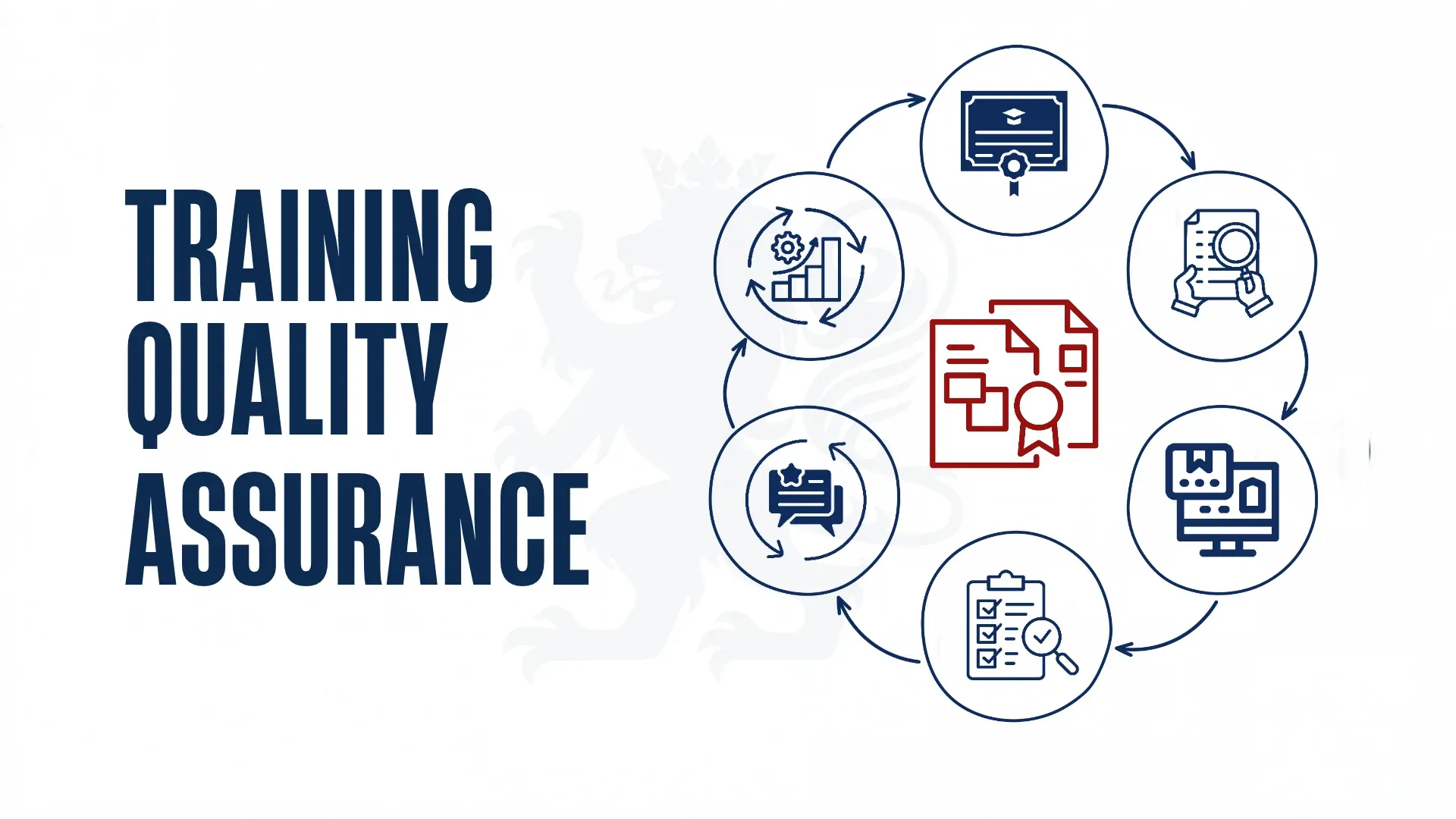
Training quality assurance is the structured process a provider uses to ensure its courses are relevant, consistently delivered and supported by reliable evidence. It covers the complete learning cycle, from identifying learner needs and writing outcomes to reviewing materials, monitoring delivery, evaluating results and making documented improvements.
What Is Training Quality Assurance?
Training quality assurance is the planned and documented process of making sure learning activities meet their intended purpose and an agreed standard. It helps a training provider answer practical questions: Is the course suitable for its intended audience? Are its learning outcomes clear? Do the materials support those outcomes? Can the provider demonstrate that the advertised learning took place?
The process is not limited to proofreading slides or collecting positive learner comments. Quality assurance in training also examines how courses are approved, how trainers are selected, how delivery is monitored, how assessments are controlled and how problems lead to improvement.
A strong system creates consistency without making every learning experience identical. Trainers may use different examples or adapt discussions to a particular group, but the essential outcomes, content, learning time and completion requirements should remain controlled.
Quality Assurance, Quality Control and Evaluation
These terms are related, but they perform different functions.
Quality assurance is preventive. It establishes the processes that should produce reliable training, such as course approval, trainer checks, version control, assessment rules and review schedules.
Quality control is detective. It checks whether a particular course, session or record meets the required standard. Reviewing a sample of marked assessments, observing a training session or checking certificates before release are quality-control activities.
Training quality evaluation considers whether the learning was useful and effective. It may examine learner feedback, knowledge gained, workplace application or wider organisational results.
A provider needs all three. Quality assurance creates the system, quality control tests whether that system is being followed, and evaluation shows whether the training is producing worthwhile results.
In simple terms, quality assurance designs the process, quality control checks the output, and evaluation considers the effect of the training.
Why Training Providers Need Quality Assurance
Training providers make promises about what learners will understand or be able to do. Training quality management helps ensure those promises are realistic, consistently delivered and supported by evidence.
Without a defined system, course quality can depend too heavily on individual trainers. One group may receive the full programme while another receives a shortened version. Learning materials can become outdated, assessments may be marked inconsistently and certificates may be issued without adequate completion evidence.
Effective training provider quality assurance can help an organisation:
- maintain consistency across trainers, locations and delivery formats;
- identify outdated or inaccurate course content;
- protect the integrity of assessments and certificates;
- respond fairly to complaints and appeals;
- demonstrate how learning hours were determined;
- retain reliable attendance and completion evidence;
- identify weaknesses before they become repeated problems;
- support external accreditation or approval applications.
Quality assurance also protects learners. They should receive a course that matches its description, supports the stated outcomes and applies clear completion requirements.
What Are Training Quality Standards?
Training quality standards are the criteria a provider uses to judge whether its learning activities are acceptable. Some standards may come from legislation, regulators, professional bodies, clients or accreditation organisations. Others will be created internally according to the provider’s services and learners.
Useful standards should be specific enough to test. “The course must be high quality” is an aspiration, not a measurable standard. A clearer requirement might state that every course must have documented learning outcomes, approved materials, a named subject reviewer, recorded learning time and a scheduled review date.
Training quality standards commonly address:
- course purpose and intended audience;
- entry requirements and assumed knowledge;
- learning outcomes;
- content accuracy and currency;
- trainer or facilitator competence;
- accessibility and learner support;
- delivery methods and active learning time;
- assessment and completion requirements;
- feedback, complaints and appeals;
- attendance and identity controls;
- records, certificates and data protection;
- review and continual improvement.
Not every provider needs the same level of documentation. The system should be proportionate to the risk, complexity and claims associated with the learning. A short awareness webinar does not require the same controls as a technical programme involving formal assessment or safety-critical workplace practice.
Building a Training Quality Assurance Framework
A training quality assurance framework brings the provider’s standards, responsibilities and review processes together. It should explain not only what must happen but also who is responsible, when checks take place and what evidence must be retained.
1. Establish governance and responsibility
Start by identifying who owns training quality at organisational level. This person does not need to complete every check, but they should be accountable for ensuring that the system operates.
Course designers, subject specialists, trainers, assessors and administrators should understand their individual responsibilities. For example, a subject specialist may confirm technical accuracy, while an administrator checks attendance records and certificate details.
There must also be a route for escalating significant concerns. If a trainer discovers outdated safety guidance during delivery, the issue should reach someone who can pause the course, correct the materials and determine whether previous learners require an update.
2. Define the learning need
Course quality assurance begins before materials are produced. The provider should be able to explain why the training is needed, who it is for and what problem it is intended to address.
Evidence may come from a skills-gap analysis, professional requirements, learner enquiries, incident reports, client consultations or changes in industry practice. Recording this need helps prevent courses from becoming collections of interesting information without a clear purpose.
3. Write measurable learning outcomes
Learning outcomes should describe what a learner is expected to know or be able to do after completing the activity. Outcomes such as “understand leadership” or “learn about compliance” are difficult to assess because they do not define an observable result.
More useful outcomes specify an action. A learner might be expected to identify common compliance risks, apply a decision-making process to a workplace scenario or produce an appropriate incident record.
The level of the outcome should match the course. A brief introductory webinar should not claim that participants will become competent practitioners unless it includes sufficient teaching, supervised practice and assessment.
4. Control course design and materials
Every course should have an authorised version. The provider should know which materials are current, who approved them and when they are due for review.
Version control can be straightforward. A course file might record its title, reference number, version, approval date, owner and next review date. Changes should also be documented so trainers know whether an update corrects formatting, replaces a legal reference or substantially changes an outcome.
Course materials should be checked for accuracy, clarity, accessibility and alignment with the learning outcomes. References should be traceable, particularly when the content concerns legal duties, safety, professional standards or technical practice.
5. Confirm trainer and assessor competence
Subject expertise does not automatically produce effective teaching, and presentation ability does not replace subject knowledge. Providers should decide what combination of qualifications, occupational experience, instructional ability and recent professional development is appropriate for each course.
The evidence may include a CV, professional registration, relevant qualifications, occupational history, observed delivery and continuing development records. The provider should also consider whether competence remains current rather than relying indefinitely on evidence collected at recruitment.
Assessors require appropriate knowledge of both the subject and the assessment method. Where judgement is involved, moderation or sampling can help prevent different assessors from applying substantially different standards.
6. Protect delivery consistency
Consistency means that every learner has a fair opportunity to achieve the published outcomes. It does not require trainers to read from a script.
Providers can support consistency with trainer guidance, session plans, required activities, minimum learning time and clearly defined completion criteria. Observations, learner feedback and periodic reviews of recorded online sessions may provide evidence of how the course is delivered in practice.
When courses are delivered by several trainers, regular standardisation discussions can resolve differences. These meetings are particularly useful when trainers interpret assessment criteria differently or frequently receive the same learner questions.
7. Control attendance, participation and completion
A certificate should represent something the provider can support with evidence. The required evidence will depend on the course, its format and the claims made.
For a live workshop, the provider might retain registration details and attendance records. For self-paced online learning, the platform may record module completion, active learning activity and assessment results. For a practical course, an assessor may need to observe performance against defined criteria.
Simply registering for a course does not necessarily demonstrate participation, and remaining logged into a platform does not always establish meaningful learning. Providers should choose controls appropriate to the risk and delivery method.
8. Design reliable assessments
Not every course requires a formal examination. However, when a provider claims that learning has been assessed, the method must be capable of testing the stated outcomes.
A multiple-choice quiz may be suitable for recalling essential facts. It is less convincing when the outcome requires the learner to analyse a complex situation, demonstrate a physical process or produce a professional document.
Assessment quality depends on clear criteria, appropriate difficulty, controlled marking, reasonable resit rules and retained evidence. Providers should also consider authenticity: can they reasonably establish that the registered learner completed the assessed work?
9. Support learners fairly
Quality assurance in learning and development includes the learner’s ability to access and complete the course. Providers should make course requirements clear before enrolment and offer a practical route for requesting support or reasonable adjustments.
Support arrangements should protect the intended learning outcome. An adjustment may change how a learner accesses content or demonstrates knowledge, but it should not remove an essential competence that the course specifically claims to assess.
Providers should also publish suitable processes for complaints, appeals and technical problems. These processes need named responsibility, response times and records of the decision.
10. Maintain dependable records
A provider should decide which records are required, how long they will be retained and who can access them. Records may include approved materials, trainer evidence, attendance, assessments, moderation, feedback, complaints, corrective actions and certificates.
Certificate controls are particularly important. A training provider should be able to trace a certificate to the learner, course, completion date and supporting evidence. Unique certificate references and a verification process can reduce errors and discourage misuse.
Data should be handled securely and in accordance with applicable privacy requirements. Quality assurance does not justify retaining personal information without a legitimate purpose.
Course Quality Assurance Before Launch
A pre-delivery review is one of the most effective ways to prevent avoidable problems. Before launching a course, a provider should confirm that the published description, outcomes, content, learning time and completion criteria agree with one another.
The review should also test the learner journey. Links, downloads, videos, assessments and automated messages need checking from a learner’s perspective. For live delivery, a pilot session can reveal unrealistic timings, unclear instructions or activities that do not work as expected.
High-risk or specialist content should receive an independent subject review where possible. The reviewer should have sufficient expertise to challenge the content rather than merely approve its presentation.
Approval should be recorded. A dated decision is more useful than an informal assumption that a course is ready because nobody raised an objection.
Quality Assurance During Training Delivery
Quality assurance should remain active once teaching begins. Trainers need a way to report errors, unexpected questions, accessibility difficulties or timings that do not work.
Monitoring may include observations, delivery checklists, platform records, assessment sampling and learner contact. The purpose is not to monitor trainers unnecessarily. It is to establish whether the planned learning experience is actually being delivered.
Problems should be considered according to their significance. A broken link may require a quick correction. An inaccurate technical instruction may justify pausing delivery, notifying affected learners and reviewing whether certificates can still be supported.
A provider that records issues but never assigns actions does not have an effective assurance system. Each material issue should have an owner, a response, a deadline and evidence of closure.
Training Quality Assessment After Delivery
Post-course review should use more than one source of evidence. Learner satisfaction can identify problems with organisation, presentation or support, but it does not prove that learning occurred.
A useful training quality assessment may consider:
- whether learners completed the intended activities;
- assessment performance and frequently missed questions;
- learner and trainer feedback;
- complaints, appeals and support requests;
- delivery observations;
- completion and withdrawal patterns;
- workplace application where this can be measured;
- client or manager feedback;
- recurring technical or administrative issues.
The evidence should be interpreted carefully. A course is not necessarily ineffective because it was challenging, and high satisfaction does not automatically mean the learning outcomes were achieved.
Training quality should be judged through combined evidence about delivery, learning and application—not through satisfaction scores alone.
Measuring Training at Different Levels
Training quality evaluation can examine several levels of result.
The first is the learning experience. Did learners find the course relevant, accessible and well organised? This provides useful early evidence, but it is the weakest basis for claiming effectiveness.
The second is learning. Did participants gain the knowledge or capability described in the outcomes? Quizzes, assignments, demonstrations or structured discussions may provide evidence.
The third is application. Did learners use the learning appropriately in their work? Follow-up surveys, manager observations, work samples or performance reviews can help, although workplace conditions may influence the result.
The fourth is organisational effect. Did the training contribute to fewer errors, improved service, faster processes or another intended result? These measures can be valuable, but providers should avoid claiming that training caused a change when other factors may also have contributed.
Providers do not need to measure every course at every level. The evaluation method should be proportionate to the course’s purpose, risk and importance.
Quality Assurance for Online and Blended Training
Online delivery introduces additional quality risks. A course may contain the correct information while still providing a poor learning experience because of inaccessible content, unreliable technology or weak participation controls.
Online course quality assurance should consider navigation, device compatibility, captions or transcripts, readable documents, technical support and the reliability of platform records. Providers should distinguish between the total time a course is available and the active learning time reasonably required.
For self-paced learning, simply dividing the number of slides by an assumed reading speed may produce an unreliable duration. Providers can use pilot testing, content analysis, video duration, mandatory activities and assessment time to reach a reasoned estimate.
Live virtual training also needs participation controls. Attendance records may be supported by trainer interaction, scheduled activities, responses or other evidence appropriate to the session. Requiring cameras to remain on is not always necessary or proportionate, particularly where privacy, connectivity or accessibility concerns exist.
Blended programmes should explain how the different elements connect. Learners need to know which activities are mandatory, how each part contributes to the outcomes and what must be completed before certification.
A Practical Training Quality Improvement Cycle
Training quality improvement is most effective when it follows a repeatable cycle.
First, establish the intended standard. Define the learning outcomes, delivery requirements, evidence and measures of success.
Second, deliver the course while retaining appropriate records. This creates evidence of what happened rather than relying on memory.
Third, examine the evidence. Look for gaps between the planned standard and actual delivery, as well as opportunities to improve the learner experience or results.
Fourth, decide what action is required. The response may involve correcting content, coaching a trainer, revising an assessment, changing learner instructions or improving an administrative process.
Finally, verify the change. A corrective action should not be treated as complete merely because a document was updated. The provider should check whether the change was implemented and whether it resolved the original issue.
This cycle turns feedback into controlled improvement instead of allowing comments to accumulate without a clear outcome.
Practical Example: Improving an Online Compliance Course
Consider a hypothetical provider delivering an online compliance course. Learner feedback is generally positive, but assessment records show that many participants answer questions about incident escalation incorrectly.
A weak response would be to make the quiz easier so more learners pass. That would improve the pass rate without addressing the learning problem.
A quality-focused provider first checks whether the assessment question is clear and correctly keyed. It then reviews the relevant lesson and discovers that the escalation process appears only in a dense paragraph near the end of a module.
The provider rewrites the section, adds a realistic decision scenario and asks a subject specialist to review the updated content. The change is recorded under a new course version. Results from the next learner group are then compared with the earlier evidence.
This is training quality improvement in practice: a problem is detected through evidence, investigated, corrected and checked again.
Training Quality Assurance and ISO 21001
Providers looking for a wider management-system reference may consider ISO 21001:2025. It is an international standard for management systems used by organisations that deliver education or training. It focuses on educational processes, learner needs, consistency and continual improvement. The standard can apply to training centres, e-learning providers and learning departments within other organisations. ISO 21001:2025
Referring to the standard does not mean every provider must obtain ISO certification. A provider may use relevant principles to inform its internal training quality assurance framework without claiming certification or conformity.
Any claim of formal certification should be accurate, current and supported by the appropriate evidence.
Training Quality Assurance and CPD Accreditation
Internal quality assurance and independent CPD accreditation are connected but separate.
A provider’s internal system controls how it designs, delivers, assesses and improves training. Independent accreditation provides an external review against the accreditation service’s published requirements. Accreditation should not replace the provider’s responsibility for maintaining quality after a review.
For an individual activity, CPD course accreditation may examine the named course, its outcomes, materials, learning time, completion evidence and certificate information.
CPD Provider Approval considers the organisation and its wider controls, such as responsibility, quality processes, learner support, records and certificate management. Provider Approval does not automatically mean every course offered by that provider has received individual course accreditation.
Applicants should review the published assessment process and evidence requirements before submitting an application.
CPD Qualifications provides independent CPD assessment and accreditation. It is not a statutory regulator or a regulated awarding organisation. CPD accreditation does not turn a course into a regulated qualification, grant a professional licence or guarantee that every employer or professional body will accept it. Providers and learners should check any profession-specific requirements separately.
Common Training Quality Assurance Mistakes
One common mistake is treating learner feedback as the entire quality system. Feedback is valuable, but learners may not be able to identify technical inaccuracies or determine whether an assessment is valid.
Another is documenting a detailed policy that is not followed in practice. A short, functioning process supported by clear records is more useful than a complex manual that staff rarely consult.
Providers may also review course content without reviewing delivery. Accurate materials can still be undermined by shortened sessions, inconsistent explanations or missed activities.
Other weaknesses include unclear learning outcomes, unsupported learning-hour claims, expired references, uncontrolled course versions and certificates issued before completion evidence has been checked.
Finally, some providers collect large volumes of data without deciding what it means. Training quality management should focus on evidence that can support a decision, reveal a risk or lead to improvement.
Summary
Training quality assurance is a continuous system covering course planning, design, trainer competence, delivery, assessment, learner support, records and improvement. Providers should define measurable standards, assign responsibility and retain evidence that those standards are being applied.
Course reviews should take place before, during and after delivery. Learner satisfaction is useful, but it should be considered alongside assessment results, observations, completion evidence, complaints and evidence of workplace application where relevant.
A practical training quality assurance framework does not need unnecessary bureaucracy. It needs clear responsibilities, controlled processes, reliable records and a genuine method for turning evidence into improvement. External accreditation can add an independent review, but the provider remains responsible for the continuing quality and accuracy of its training.
Frequently asked questions
What is training quality assurance?
Training quality assurance is the planned process used to ensure training is properly designed, consistently delivered, appropriately assessed and continually improved. It includes standards, responsibilities, checks, records and corrective actions.
What does quality assurance mean in training?
It means building quality controls into the complete training process instead of relying on a final check. These controls may cover learning outcomes, course materials, trainer competence, delivery, assessment, learner support and certification.
What is a training quality assurance framework?
A training quality assurance framework is the organised set of policies, standards, responsibilities and review activities a provider uses to manage quality. It explains what must be checked, who performs each check and what evidence is retained.
What are training quality standards?
Training quality standards are the criteria used to judge whether a course or provider meets an acceptable level of quality. They may cover accuracy, outcomes, accessibility, trainer competence, learning time, assessment, records and learner support.
How can providers assure course quality?
Providers can define learning needs and outcomes, review content, verify trainer competence, control course versions, monitor delivery, check assessments, retain completion evidence and evaluate results. Identified problems should lead to recorded corrective action.
What is the difference between training quality assurance and evaluation?
Quality assurance manages the processes intended to produce reliable training. Evaluation examines the learning experience and its results. Evaluation is therefore an important part of the wider quality-assurance system.
How is training quality assessed?
Training quality can be assessed through material reviews, delivery observations, assessment sampling, attendance evidence, learner feedback, complaints, completion patterns and measures of learning or workplace application.
Does positive learner feedback prove that training is effective?
No. Positive feedback may show that learners enjoyed the course or found it well organised, but it does not by itself prove that they achieved the learning outcomes or applied the learning correctly.
How often should a training course be reviewed?
The review frequency should reflect the subject’s risk and rate of change. Courses should also be reviewed when legislation, professional guidance, technology or source material changes, or when feedback and assessment evidence identify a possible weakness.
Does CPD Provider Approval accredit every course?
No. Provider Approval and individual course accreditation are separate forms of review. Approval of a provider should not be presented as evidence that every course in its catalogue has been individually accredited.