

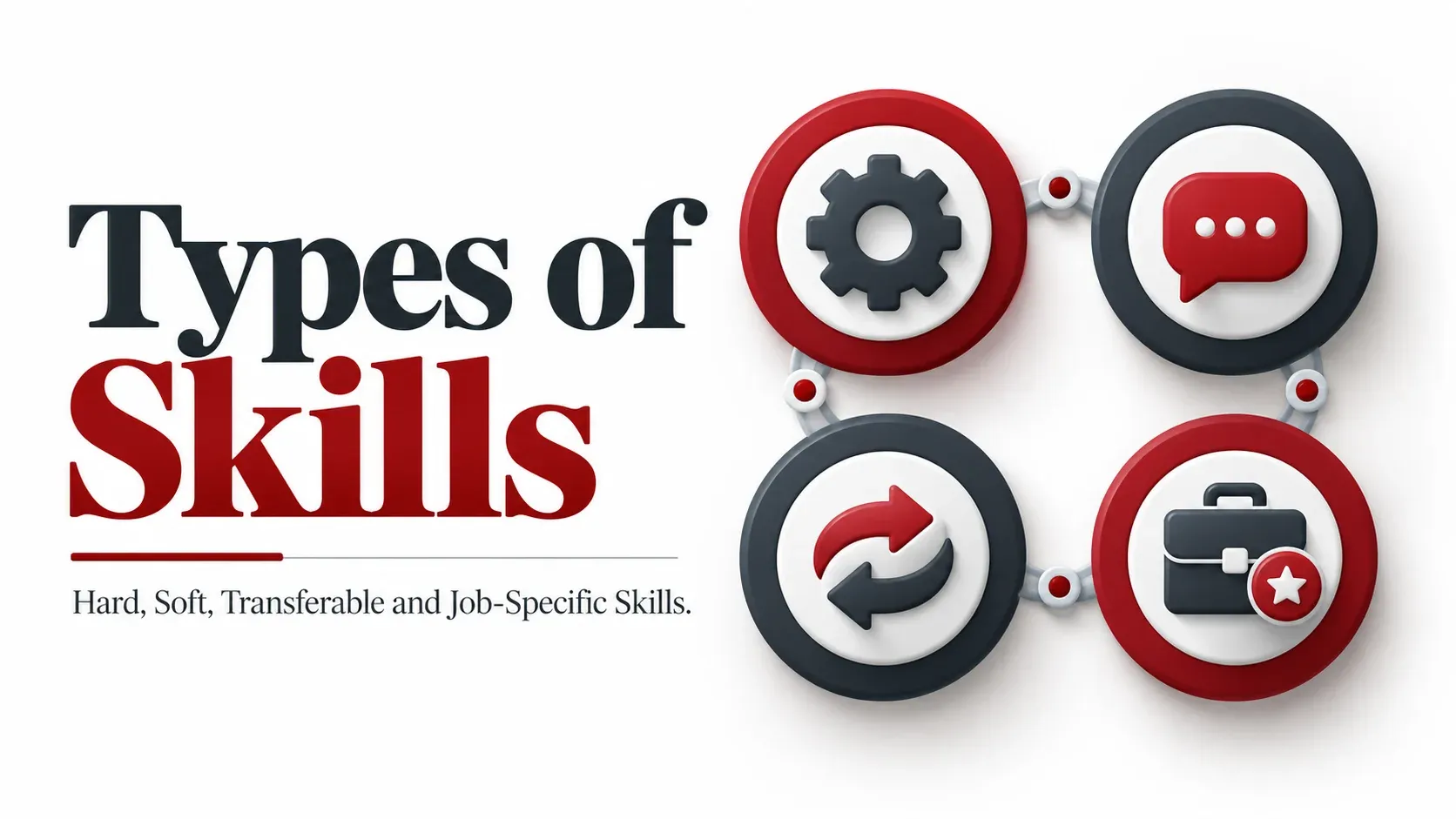
Skills are abilities that help people complete tasks, solve problems and perform effectively in different situations. They can be developed through education, professional development, employment, volunteering and everyday experience. Understanding the different types of skills can help you recognise your strengths and identify areas that need further development.
Most jobs require a combination of technical knowledge and broader workplace abilities. For example, an employee may need to use specialist software while also communicating with customers, organising deadlines and working with colleagues. The exact combination depends on the role, industry and level of responsibility.
Recognising your skills is also useful when preparing a CV or job application. Instead of copying a general job skills list, you can select capabilities that match the vacancy and support them with evidence from your experience. This gives an employer a clearer picture of what you can do and how your abilities relate to the position.
What Are Skills?
A skill is the ability to perform a task or use knowledge effectively. Some skills involve practical or technical work, such as operating equipment, analysing data or using software. Others affect how someone communicates, makes decisions, manages responsibilities or works with other people.
Skills are connected to knowledge, experience and competence, but these terms have different meanings. Knowledge describes what a person understands, while a skill is their ability to use that understanding. Experience comes from exposure to relevant situations, and competence usually involves applying appropriate knowledge, skills and judgement to the expected standard.
A person can develop skills through several forms of learning. A course may introduce a method, but practice is normally needed before the learner can use it confidently. Feedback and reflection can then show whether the skill has improved and what further learning may be required.
Different Types of Skills
Skills can be grouped according to how they are learned, where they are used and whether they relate to a particular occupation. The categories frequently overlap because one workplace task may require technical ability, communication and judgement at the same time. The purpose of these categories is to make skills easier to understand and develop.
The main types of skills include:
- Hard skills
- Soft skills
- Transferable skills
- Job-specific skills
- Specialist skills
- Digital skills
- Interpersonal skills
- Management and leadership skills
- Practical skills
- Personal skills
Employers may use terms such as professional skills, work skills, employee skills, competencies or abilities. These labels can cover several different categories. Applicants should therefore examine the task or behaviour being requested rather than relying only on the wording used.
Hard Skills
Hard skills are technical, practical or measurable abilities used to perform particular tasks. They are often learned through education, training or supervised practice. Some hard skills can be demonstrated through a qualification, assessment, work sample or practical test.
Examples of hard skills include:
- Bookkeeping
- Data analysis
- Programming
- Graphic design
- Operating machinery
- Using accounting software
- Preparing financial reports
- Project scheduling
- Foreign-language proficiency
- First aid
- Using customer management software
- Following technical procedures
Hard skills may be specific to a job or useful across several related occupations. Spreadsheet ability, for example, may be useful in administration, finance, marketing and project management. The required level may still differ significantly between a basic administrative task and complex financial analysis.
Technical skills can become outdated as technology, guidance and working practices change. Someone who learned a system several years ago may need updated training or additional practice. Professional development can help people refresh existing hard skills and build new ones as their responsibilities change.
Soft Skills
Soft skills influence how a person approaches work, communicates and responds to other people. They are sometimes described as behavioural, personal or interpersonal skills. Although they are less technical than hard skills, they can strongly affect how effectively someone performs their role.
Examples of soft skills include:
- Communication
- Teamwork
- Problem-solving
- Adaptability
- Time management
- Organisation
- Leadership
- Creativity
- Decision-making
- Attention to detail
- Emotional awareness
- Conflict management
Soft skills are normally demonstrated through behaviour rather than a certificate. For example, someone may show teamwork by coordinating responsibilities, sharing relevant information and helping a group meet a deadline. An example of problem-solving could explain how the person identified an issue, compared possible solutions and reviewed the outcome.
General claims such as “excellent communicator” or “strong team player” provide limited evidence on their own. A stronger description explains the situation, the action taken and the result. This allows an employer to assess how the skill was used in practice.
Transferable Skills
Transferable skills can be applied across different roles, organisations and industries. They may have been developed in one setting but remain useful in another. These skills are especially important for people changing careers, returning to employment or applying without direct experience in the same type of role.
Examples of transferable skills include:
- Written communication
- Verbal communication
- Organisation
- Planning
- Research
- Problem-solving
- Teamwork
- Customer service
- Leadership
- Prioritisation
- Presentation
- Record keeping
The setting in which a skill was developed does not need to be identical to the new role. Someone who organised a voluntary community project may have developed planning, communication and coordination skills. Those abilities may also be relevant to an administrative, events or project-support position.
Applicants should explain how the capability transfers to the vacancy. The example should show a relevant action or outcome instead of relying only on the name of the skill. This helps an employer connect previous experience with the work the applicant would be expected to perform.
Job-Specific and Specialist Skills
Job-specific skills are abilities required to perform the tasks of a particular position. They may relate to an occupation, piece of equipment, technical process or professional responsibility. These skills commonly appear in the essential or desirable criteria of a job description.
Examples include:
- Preparing payroll for a payroll position
- Using computer-aided design software for a design role
- Writing code in a specified programming language
- Operating specialist production machinery
- Conducting workplace risk assessments
- Using a hospitality booking system
- Applying a defined clinical procedure where authorised
- Producing technical drawings
Specialist skills usually involve deeper capability within a specific subject. A general marketing position may require communication and digital skills, while a specialist search marketing role may require detailed analytical and technical abilities. The person may need significant training and practice before they can work independently.
Applicants should distinguish between awareness of a subject and the ability to complete a specialist task. If a job requires formal authorisation, registration or a particular qualification, general experience may not satisfy that requirement. The job information should be reviewed carefully before making a claim.
Digital Skills
Digital skills involve using technology to complete tasks, manage information and communicate. Basic digital skills are required in many workplaces, while other jobs need advanced technical capability. The tools used may vary between organisations and industries.
Examples of digital skills include:
- Using email and online meeting platforms
- Creating documents and spreadsheets
- Managing digital files
- Entering and checking data
- Using cloud-based systems
- Working with role-specific software
- Creating digital content
- Understanding basic online security
- Analysing information with digital tools
- Troubleshooting common technical problems
Writing “computer skills” on a CV may be too broad to be useful. Naming the relevant software or task gives the employer clearer information. Applicants should also describe their level accurately rather than using terms such as “expert” without evidence.
Digital capabilities require regular review because systems and working practices change. A person may be confident using one platform but need support when an employer uses another. Learning how to adapt existing knowledge to a new tool can itself be a valuable transferable skill.
Interpersonal Skills
Interpersonal skills help people communicate and work with others. They are important in customer service, teamwork, management and any role involving professional relationships. These skills affect how information is shared, disagreements are handled and support is provided.
Examples include:
- Active listening
- Clear verbal communication
- Asking relevant questions
- Giving constructive feedback
- Showing appropriate empathy
- Managing disagreements
- Adjusting communication for the audience
- Building professional relationships
- Collaborating with colleagues
- Responding calmly under pressure
Interpersonal skills are not limited to naturally confident or outgoing people. They can be improved through preparation, practice, observation and feedback. Different situations may also require different approaches, so an effective communicator should be able to adjust their style.
An applicant can demonstrate interpersonal ability with an example involving a customer, colleague or stakeholder. The example should explain what the person did and how their approach helped the situation. A specific account is more informative than a general description of personality.
Management and Leadership Skills
Management and leadership skills help people coordinate work, support others and make accountable decisions. They may be required in formal management positions, but employees can also develop them by leading projects or taking responsibility for a defined activity.
Examples include:
- Setting clear expectations
- Planning work
- Delegating responsibilities
- Monitoring progress
- Giving feedback
- Supporting employee development
- Managing resources
- Making decisions
- Resolving problems
- Communicating change
- Managing risk
- Evaluating outcomes
Management and leadership are related but not identical. Management commonly focuses on organising responsibilities, resources and processes, while leadership often involves direction, influence and supporting people through change. Many roles require a combination of both.
Developing these skills normally requires practical experience as well as knowledge. A course may explain delegation or feedback, but the learner also needs opportunities to apply the approach. Reflection and feedback can then help them improve how they manage real situations.
What Are Work Skills?
Work skills are the combined technical, transferable and behavioural abilities used in employment. They help a person complete tasks, communicate, manage responsibilities and respond to workplace expectations. Different jobs require different combinations, so no single list represents every role.
Common work skills include:
- Communicating clearly
- Organising tasks
- Managing time
- Working with colleagues
- Solving problems
- Following procedures
- Using relevant technology
- Maintaining accurate records
- Responding to feedback
- Adapting to change
- Taking responsibility
- Paying attention to detail
A workplace task often requires several skills at once. Completing a project may involve technical knowledge, planning, communication and decision-making. Looking at the full task can help someone identify capabilities they might otherwise overlook.
Work skills are not developed only through paid employment. Education, volunteering, caring responsibilities, community activities and personal projects may all provide relevant evidence. The important question is whether the experience demonstrates a capability needed for the job.
What Skills Do You Need for a Job?
The skills needed for a job depend on its responsibilities and working environment. Employers may require technical abilities, communication skills and particular standards of behaviour. Some roles also have mandatory qualifications, licences or registrations.
Five broadly useful skills for many jobs are:
- Communication
- Organisation
- Problem-solving
- Teamwork
- Adaptability
These five skills should not be treated as a universal answer for every vacancy. A data-focused role may place greater emphasis on analysis and attention to detail, while a customer-facing role may prioritise communication and service. Technical occupations may require abilities that cannot be replaced by general workplace skills.
The job description and person specification provide the best starting point. Look for repeated tasks, responsibilities and essential criteria. These details usually indicate the abilities that will be assessed during the application and interview process.
Job Skills List and Examples
The following sample job skills are grouped by the workplace purpose they support.
Communication skills
- Writing clear emails
- Preparing reports
- Explaining information
- Listening carefully
- Delivering presentations
- Adjusting language for different audiences
Organisation skills
- Planning workloads
- Meeting deadlines
- Maintaining records
- Scheduling activities
- Prioritising tasks
- Coordinating resources
Problem-solving skills
- Identifying the cause of an issue
- Gathering relevant information
- Comparing possible solutions
- Making evidence-based decisions
- Responding to unexpected difficulties
- Reviewing whether a solution worked
Teamwork skills
- Sharing relevant information
- Supporting colleagues
- Coordinating responsibilities
- Contributing to group decisions
- Managing disagreements appropriately
- Working towards shared goals
Customer service skills
- Understanding customer needs
- Explaining products or services
- Managing complaints appropriately
- Recording information accurately
- Following up on agreed actions
- Maintaining professional communication
Leadership skills
- Setting expectations
- Delegating work
- Monitoring progress
- Giving constructive feedback
- Supporting team development
- Taking responsibility for decisions
A job may require abilities from several of these groups. Applicants should avoid placing the entire list in a CV or application. A smaller selection of relevant skills supported by evidence is normally more useful.
Skills for a Job Application
Skills included in a job application should match the requirements of the vacancy. Begin by reviewing the job description, person specification and application questions. Identify the essential skills and decide which experiences provide the strongest evidence.
A useful skills example usually explains:
- The situation or responsibility
- The action you took
- The skill you used
- The result you achieved
- What you learned, where relevant
Instead of writing “I have strong organisational skills,” explain how you managed competing deadlines, created a clear system and completed the work on time. This gives the employer something specific to assess. It also shows how the skill affected a real outcome.
Keep every claim accurate. Avoid adding a skill because it sounds impressive if you cannot explain where or how you used it. An exaggerated claim may be tested during an interview, assessment or practical task.
Skills for a CV or Resume
A CV skills section can provide a concise overview of capabilities that relate to the target job. In the UK, “CV” is the more common term, although “resume” may be used by international employers. The same principle applies to both documents: select relevant skills and support them elsewhere.
Specific descriptions are more helpful than broad terms. “Experienced with monthly financial reporting and spreadsheet analysis” provides more information than “excellent computer skills.” The employment or project section can then explain where that capability was used.
Avoid filling the section with generic qualities that could appear on any applicant’s CV. Skills such as communication and teamwork can still be included, but they should be supported by relevant achievements or responsibilities. Tailoring the section to each position makes it more meaningful.
Employee Skills Employers May Value
Employers often value people who can complete the technical requirements of a role and work effectively within the organisation. Communication, reliability, problem-solving and adaptability appear across many vacancies. Their importance still depends on the position and working environment.
Commonly valued employee skills include:
- Relevant technical ability
- Clear communication
- Teamwork
- Reliability
- Organisation
- Time management
- Problem-solving
- Adaptability
- Customer awareness
- Digital capability
- Initiative
- Attention to detail
- Leadership
- Willingness to learn
A willingness to learn can be valuable when roles or technologies are changing. However, it does not replace an essential qualification or ability that must be present from the start. Applicants should distinguish between requirements they already meet and areas they would need to develop.
Employer priorities may differ between jobs with the same title. One organisation may place greater emphasis on customer contact, while another may prioritise reporting or technical knowledge. Applications should respond to the specific vacancy rather than assume every employer wants an identical set of skills.
Skills vs Qualifications
A skill is an ability that someone can use to perform or contribute to a task. A qualification is a formal award gained after completing specified learning and assessment. Qualifications can provide evidence of knowledge or ability, but they do not represent every capability needed at work.
Some roles require particular qualifications, registrations or licences. In those cases, general experience may not replace the formal requirement. Other employers may accept equivalent experience when the person can demonstrate the necessary skills.
Job descriptions often separate required qualifications from essential skills. Applicants should review both categories and avoid treating them as interchangeable. If the requirement is unclear, the recruiting organisation can explain what evidence it will accept.
How to Identify Your Skills
People sometimes overlook skills they use regularly because the work feels familiar. Reviewing previous jobs, education, volunteering and independent projects can reveal capabilities that may be relevant to future opportunities. Feedback from colleagues, managers or tutors may identify additional strengths.
Begin by listing tasks or responsibilities you have completed. For each one, consider the knowledge, decisions and actions it required. Organising an event, for example, may demonstrate planning, communication, budgeting, teamwork and problem-solving.
You can then compare your skills with the requirements of roles that interest you. This may reveal areas where you already have suitable evidence and areas that need further development. The aim is to create an accurate skills profile rather than force every experience to match a vacancy.
How to Develop Your Skills
Skills development begins with identifying what you need to improve and why. A clear goal helps you choose the right learning method and decide how progress will be reviewed. Without a defined purpose, it is easy to complete training that has little connection to your work or career plans.
Ways to develop skills include:
- Completing a relevant course
- Participating in workplace training
- Working with a mentor or coach
- Observing an experienced colleague
- Taking responsibility for a supervised project
- Practising through realistic tasks
- Reading current professional guidance
- Asking for focused feedback
- Reflecting on completed work
- Volunteering for relevant responsibilities
The learning method should match the skill. Technical knowledge may be introduced through a course, while communication or leadership may require repeated practice and feedback. Some development goals need a combination of structured learning and workplace experience.
Our mother guide to professional development explains how to identify learning needs, set goals and choose development activities. It also shows how courses, workplace learning and reflection can support continued growth.
How CPD Can Help Build Workplace Skills
Continuing Professional Development can help professionals maintain existing skills and develop capabilities needed for changing responsibilities. CPD may include courses, workshops, mentoring, reading, workplace projects and reflective learning. The activity should be selected according to the skill being developed.
A formal course may be suitable when someone needs structured knowledge. Coaching or supervised practice may be more effective when the goal involves behaviour, judgement or practical performance. Combining learning methods can help someone understand a subject and use it with greater confidence.
CPD should not be measured only by the number of activities or certificates completed. A stronger approach identifies a skills gap, applies the learning and reviews the result. Our guide explaining why CPD is important examines how relevant development can support professional capability and workplace performance.
Summary
Skills are abilities that help people perform tasks and respond effectively to different situations. The main types include hard, soft, transferable and job-specific skills, although the categories often overlap. Most jobs require technical capability alongside broader skills such as communication, organisation and problem-solving.
The best skills for a job application are those that match the responsibilities and selection criteria of the position. Applicants should choose a focused set of relevant capabilities and support them with accurate examples. Evidence can come from employment, education, volunteering or independent projects.
Skills continue to develop through professional learning and experience. Courses, workplace practice, mentoring, feedback and CPD can all help people address skills gaps. Development is most useful when it has a clear goal, includes practical application and leads to a review of what improved.
Frequently asked questions
What are the different types of skills?
The main types include hard skills, soft skills, transferable skills and job-specific skills. Other categories include digital, interpersonal, management, practical and personal skills. These groups overlap because many workplace tasks require several abilities at once.
What are examples of skills?
Examples include communication, teamwork, organisation, programming, data analysis, leadership and customer service. Some skills are technical or job-specific, while others can transfer across several occupations. Their relevance depends on the work being performed.
What are good skills to have for a job?
Communication, organisation, problem-solving, teamwork and adaptability are useful in many jobs. The best skills still depend on the responsibilities and requirements of the position. Applicants should use the job description to identify which abilities matter most.
What skills do you need for a job?
You need the essential technical, practical and workplace skills stated for the role. Some jobs also require specific qualifications, registrations or licences. The vacancy information should identify the minimum criteria.
What are examples of job skills?
Examples include using role-specific software, communicating with customers, maintaining records, managing deadlines and solving workplace problems. A particular job may require a different combination. Review its responsibilities to find the most relevant examples.
What skills should I put on a job application?
Include skills that match the selection criteria and that you can support with evidence. Explain how you used each important skill and what outcome you achieved. Avoid listing attractive terms without practical examples.
What skills should I put on my CV?
Choose technical, transferable and job-specific skills relevant to the target role. Support them through your employment, education or project history. Specific descriptions usually provide more value than broad claims.
What are transferable skills?
Transferable skills can be used across different roles, organisations and industries. Examples include communication, organisation, research, teamwork and problem-solving. They are particularly useful when changing careers or applying without direct experience in the same field.
What is the difference between hard skills and soft skills?
Hard skills are technical or practical abilities that can often be taught and assessed. Soft skills relate to communication, behaviour and how someone approaches work. Most jobs require a combination of the two.
What are special skills for jobs?
Special or specialist skills are closely connected to a particular occupation or area of work. They may involve technical processes, equipment, software or professional knowledge. Some specialist tasks require formal training, registration or authorisation.
What skills do employers value?
Employers commonly value relevant technical ability, communication, reliability, teamwork, problem-solving and adaptability. Priorities vary according to the vacancy and organisation. The job description provides the clearest indication of what a particular employer values.
What is the difference between skills and qualifications?
Skills are abilities that someone can apply, while qualifications are formal awards gained through assessment. A qualification may provide evidence of learning but does not represent every capability required for a job. Some positions require both qualifications and demonstrated skills.
How can I develop my professional skills?
Identify the capability you need, choose a suitable learning activity and find an opportunity to practise. Ask for feedback and review whether your performance changed. Courses, mentoring, workplace projects and CPD can all contribute when they match your development goal.