
Career development is the ongoing process of understanding where you are in your working life, deciding where you may want to go and taking practical steps towards that direction. It can involve gaining experience, developing relevant skills, changing responsibilities, becoming a specialist or preparing for a different career.
It does not always mean earning a promotion or moving into management. Someone may develop their career by deepening their expertise, moving into work that better suits their priorities, returning after a career break or becoming more capable in their present role.
This guide explains the meaning and importance of career development, how it differs from professional development and how to make realistic career progress.
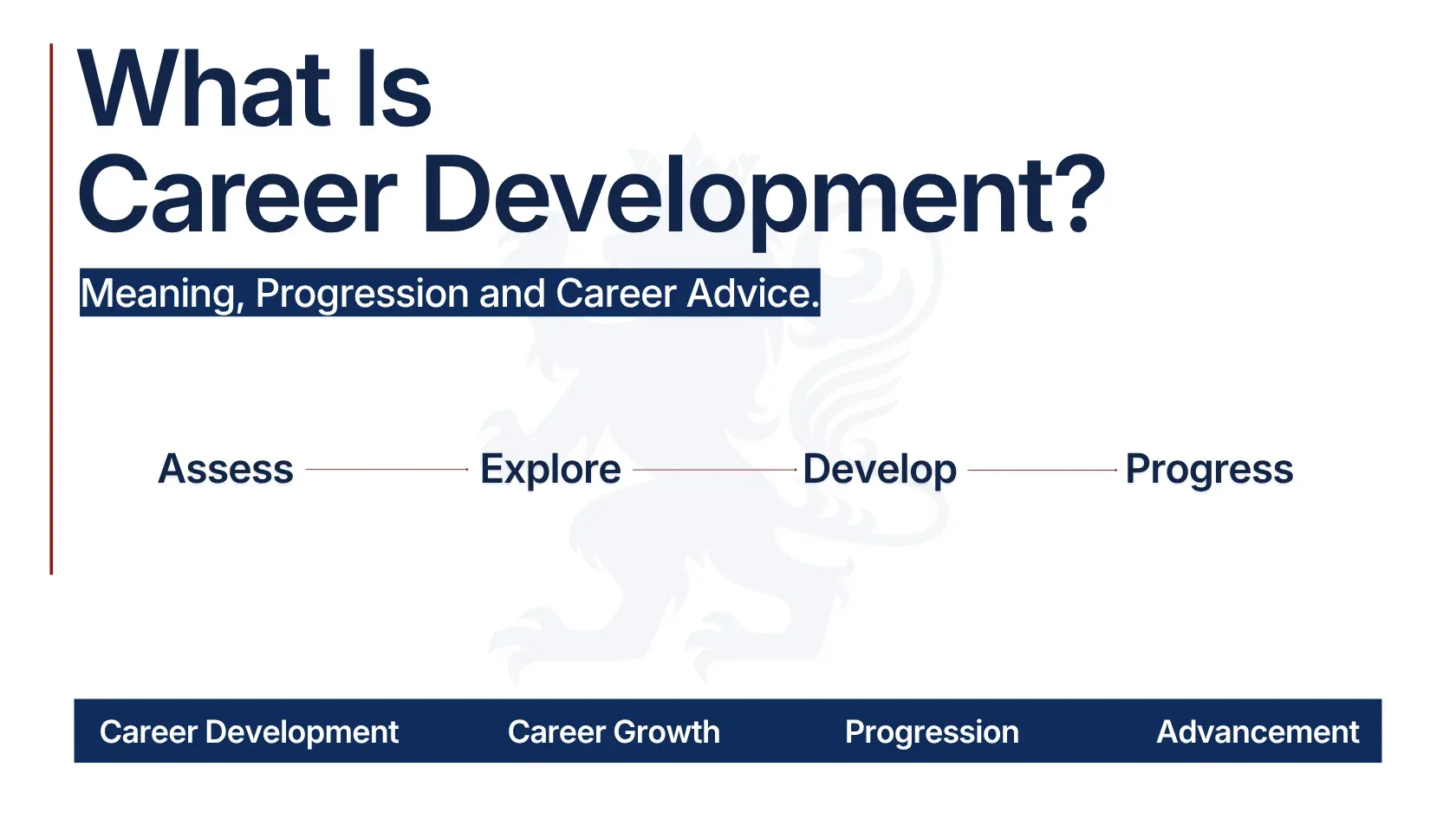
What Is Career Development?
Career development is the continuing process of exploring career options, making informed decisions and building the skills, experience and qualifications needed for future opportunities.
It begins with understanding your current position and what you might want from your working life. This could involve preparing for promotion, becoming a specialist, changing careers or improving your position within an existing role.
Three questions can help guide the process:
- Where am I now in my career?
- Where would I like to go?
- What experience, skills or qualifications would help me take the next step?
Career development can begin before someone enters employment and continue throughout their working life. Because interests, circumstances and opportunities change, the process should remain flexible rather than follow a rigid plan.
This definition of career development also recognises that careers do not always move upwards in a straight line. A lateral move, temporary assignment or deliberate change in working pattern may support someone’s longer-term direction even when it does not produce an immediate promotion.
Career Development vs Professional Development
Career development concerns the broader direction of your working life. Professional development concerns the learning and experience that help you improve or prepare for professional responsibilities.
For example, someone’s career goal may be to become a project manager. Their professional development could include learning project-planning methods, assisting with projects, receiving mentoring and leading a small assignment.
Career development identifies the direction. Professional development helps build some of the capabilities required to move in that direction.
The two processes support each other, but they are not identical. Someone can complete professional development without seeking a promotion or career change. They may simply want to remain effective in their present position.
For a broader explanation of workplace learning, read our guide to professional development.
Career Development vs Career Growth
Career growth describes the positive change someone experiences during their career. This might include greater expertise, confidence, responsibility, influence or independence.
Career development is the process that can support that growth. It involves understanding possible directions, identifying requirements and taking relevant action.
Growth does not always mean receiving a higher job title. A person may become more skilled in the same role, gain recognition as a specialist or move into work that provides greater satisfaction. These outcomes can represent meaningful career growth without conventional promotion.
What Is Career Advancement?
Career advancement usually means moving into a position with greater responsibility, authority, professional level or reward.
Examples include:
- Receiving a promotion
- Moving from an assistant position to an independent role
- Becoming a supervisor or manager
- Progressing to a senior specialist position
- Taking responsibility for larger or more complex projects
- Moving into a higher professional grade
- Moving into a role with greater remuneration or a more advanced level of responsibility
Career advancement is one possible result of career development. It is not the only result, and completing training does not guarantee it.
Advancement may depend on performance, experience, organisational need, available positions and the requirements of the target role. Learning can help someone prepare, but it cannot create an opportunity that does not exist.
What Is Career Progression?
Career progression is movement through roles, responsibilities or professional levels over time. It may occur within one organisation, across several employers or through a change in occupation.
Progression can be vertical, such as moving into a more senior role. It can also be lateral, such as transferring to another department to gain experience or entering a different specialism at a similar organisational level.
A lateral move may be an important progression step when it provides experience required for a longer-term goal. Career progress should therefore be assessed against the person’s intended direction rather than their job title alone.
Career development, career growth, progression and advancement are connected, but they are not interchangeable. Development is the ongoing process of preparing for professional opportunities. Growth describes improvement in capability or experience, while progression and advancement describe changes in a person’s career position or responsibilities.
Someone can develop professionally without changing jobs, and a promotion is not necessarily the best career decision for every individual.
Why Is Career Development Important?
Career development gives people a clearer basis for making decisions about work, experience and learning. Without a direction, it is easy to complete unrelated courses, apply for unsuitable jobs or accept responsibilities that do not support longer-term priorities.
A career direction can help someone identify which opportunities deserve their time. It can also reveal whether a desired role requires additional experience, a qualification, professional registration or a particular technical capability.
Career development can support:
- More informed career decisions
- Clearer short- and long-term goals
- Better use of learning opportunities
- Preparation for changing responsibilities
- Greater awareness of available career paths
- Stronger evidence for applications and progression discussions
- Adaptation to changes in work or personal circumstances
A plan cannot guarantee a particular career outcome. Its value is that it turns a broad ambition into decisions and actions that can be reviewed.
Career Development Is Not Only About Promotion
Promotion is only one possible career objective.
Someone may want to become a recognised specialist without managing a team. Another person may seek flexible work, reduced travel or responsibilities that better suit their health or family circumstances. Someone returning after a career break may initially focus on rebuilding recent experience and professional confidence.
Career development can involve:
- Deepening specialist expertise
- Improving performance in a current position
- Moving into a related field
- Changing occupation
- Returning to employment
- Preparing for self-employment
- Developing a portfolio career
- Adjusting work around personal circumstances
- Taking on leadership responsibilities
- Deliberately moving into a less demanding role
The right direction depends on what the person values, their circumstances and the opportunities realistically available.
Who Is Responsible for Career Development?
Individuals have an important role in understanding their goals, investigating options and taking action. However, career development does not depend entirely on personal effort.
Employers influence access to projects, learning, mentoring, promotion and internal movement. Managers can provide feedback, explain possible pathways and help employees understand what a more advanced role requires.
Educational institutions, professional bodies, mentors and careers advisers may also provide information and support. The National Careers Service offers official guidance on career choices, employment and progression.
Career development is often a shared process, but employers cannot guarantee that a preferred opportunity will become available. Individuals should remain aware of possibilities both within and beyond their present organisation.
How to Begin Developing Your Career
Start by reviewing your current position without assuming that your next move must be upwards.
Consider which parts of your work you find engaging, which responsibilities you perform well and which activities you would prefer to do less often. Feedback, achievements and difficult tasks can reveal patterns that are useful when considering future directions.
Next, research possible roles. Read current job descriptions, speak with people doing relevant work and investigate qualification or professional requirements. This helps replace assumptions with evidence about what the work actually involves.
Compare your present experience with the requirements of the target role. The gap may involve technical knowledge, practical experience, management responsibility, professional evidence or a formal qualification.
Only after identifying that gap should you select development activities. This reduces the likelihood of completing learning that sounds useful but has little connection to the intended career step.
How to Create a Career Development Plan
A career development plan records your intended direction, the requirements of the next step and the actions you plan to take.
1. Describe your career direction
State what you want to explore or achieve. The direction can remain provisional if you are considering several options.
“Become more successful” is too vague. “Explore whether project coordination would be a suitable next step” creates a clearer starting point.
2. Research the target
Review current job descriptions, career pathways and professional requirements. Speak with someone familiar with the work where possible.
Find out what the position involves in practice rather than relying only on its title.
3. Assess your current position
List the relevant experience, knowledge, skills and qualifications you already possess. Use examples and evidence instead of relying entirely on confidence or self-perception.
4. Identify the gap
Compare your current profile with the target requirements. Separate essential requirements from capabilities that are merely desirable.
A mandatory qualification, licence or registration must be treated differently from a general skill that can be strengthened through experience.
5. Select practical actions
Actions might include structured learning, mentoring, job shadowing, volunteering, a workplace project or moving into a role that provides relevant experience.
Each action should address an identified requirement rather than add another unrelated activity to your record.
6. Set a realistic timeframe
Divide a longer-term aim into manageable steps. The National Careers Service guidance on understanding and developing skills recommends using specific, measurable, achievable, relevant and time-bound goals while keeping a career plan flexible.
For example, someone interested in project coordination could set a goal to assist with one internal project over the next three months. They could take responsibility for maintaining the task schedule, attend project-review meetings and ask the project manager for feedback at the end.
This creates a specific development opportunity with a timeframe and evidence of practical experience. It does not guarantee promotion, but it can help the employee assess their readiness for future opportunities.
7. Review the plan
Career plans should change when circumstances, interests or opportunities change. Review your progress and decide whether the original direction still makes sense.
An action that does not produce the expected result can still provide useful information. It may show that the goal needs to change or that another route would be more suitable.
Example of Career Development
Consider an experienced administrator who wants to move into project coordination.
The employee reviews several project-coordinator vacancies and identifies recurring requirements: maintaining schedules, preparing records, communicating with stakeholders and monitoring deadlines.
They already have strong administrative and communication experience but limited exposure to formal project work. Their development actions could include assisting with an internal project, shadowing a project manager and completing relevant introductory learning.
During the project, they maintain the task schedule and prepare updates for review meetings. At the end, they request feedback and record specific examples of their responsibilities.
They can then update their CV and decide whether they are ready to apply for a project-coordinator role or need further experience. The example connects a career direction with research, action and evidence rather than assuming that completing a course will lead automatically to advancement.
Career Development Advice
Career development advice should help you make informed decisions rather than promise one ideal route.
Focus on the next useful step
A distant career goal may feel difficult to reach. Concentrate on the next action that could improve your position, such as gaining relevant experience, discussing internal opportunities or researching a required qualification.
Use current job information
Job titles can have different meanings between organisations. Review several recent vacancies to understand what employers request for the work that interests you.
Build evidence, not only knowledge
Knowing about a responsibility is different from having experience of it. Look for appropriate opportunities to apply learning and produce evidence of what you can do.
Discuss progression with your manager
A manager may be able to explain internal pathways, upcoming projects and areas you need to strengthen. Approach the conversation with a specific objective rather than a general request to progress.
The UK government’s career improvement guidance recommends discussing progression, training and additional responsibilities with an employer.
Keep more than one route open
A career goal may have several possible routes. An internal transfer, external application, qualification or related role could each contribute to the same longer-term direction.
Review your priorities
A direction that suited you several years ago may no longer match your circumstances. Changing a plan after gaining better information is not a failure.
Career Growth Tips
Career growth is usually gradual. These actions can help make it more deliberate:
- Keep a record of responsibilities and results.
- Ask for feedback connected to a specific career objective.
- Study the requirements of roles that interest you.
- Develop relationships with people who understand the field.
- Volunteer for relevant responsibilities without exceeding your competence.
- Update your CV as you gain experience.
- Identify mandatory qualifications or registrations early.
- Review your career direction periodically.
- Learn how your organisation makes progression decisions.
- Avoid assuming that more training automatically produces advancement.
The most useful action depends on the gap between your current position and the target. Someone lacking technical knowledge needs a different approach from someone who has the knowledge but lacks practical evidence.
Suggestions for Career Development at Work
Employees can explore career opportunities without immediately leaving their organisation.
A workplace discussion might cover upcoming projects, job shadowing, temporary responsibilities, mentoring or movement between departments. Employees can also ask what evidence decision-makers expect when considering someone for progression.
Internal opportunities can be valuable because the employer already understands the person’s work. However, employees should still research the wider employment market. Their present organisation may not offer the role, specialism or pathway they want.
Employers can support career development by explaining possible routes and the capabilities expected at different levels. This does not require promising promotion. It provides employees with better information for making realistic decisions.
How Professional Development Supports Career Development
Professional development can help someone gain knowledge, skills and experience relevant to a career goal.
A person preparing for management might develop delegation, feedback and decision-making. Someone seeking a specialist position may require deeper technical learning and supervised experience.
The connection should remain specific. Completing a course because it appears impressive is less useful than selecting learning that addresses an identified requirement of the target role.
Professional development may improve someone’s readiness, but it does not guarantee advancement. Employers may also consider experience, performance, qualifications and available opportunities.
Our guide to professional development activities provides practical learning options once a career-related need has been identified.
How CPD Relates to Career Development
Continuing Professional Development can form part of career development when it addresses knowledge or skills relevant to a current or future role.
CPD may include courses, workshops, mentoring, professional reading and workplace learning. Where a professional scheme applies, learners should follow its eligibility, evidence and reporting requirements.
A CPD certificate can provide evidence of completing a learning activity, but it does not automatically demonstrate professional competence or guarantee promotion or employment.
Its career value depends on the relevance of the learning, the requirements of the intended role and the learner’s ability to apply or demonstrate what they developed.
Common Career Development Mistakes
One mistake is treating promotion as the only acceptable outcome. This can cause people to overlook specialist, lateral or flexible opportunities that may suit them better.
Another is completing training before researching the target role. The course may be interesting but irrelevant to what the position requires.
People may also create plans based on job titles instead of actual responsibilities. Speaking with someone in the role and reviewing several vacancies can provide a more accurate picture.
Other mistakes include setting goals without timeframes, ignoring mandatory qualifications and waiting for an employer to manage the entire process.
Career development should not be treated as a guarantee. A thoughtful plan improves preparation and decision-making, but opportunities are still affected by organisational, economic and personal circumstances.
Summary
Career development is the continuing process of managing the direction of your working life. It involves understanding your current position, exploring possible paths and taking practical steps towards suitable career goals.
It may lead to career advancement or progression, but it is not limited to promotion. Career development can include specialisation, lateral movement, career change, returning to employment or becoming more capable in an existing position.
A useful career plan connects a realistic direction with the experience, skills, qualifications and evidence required. Professional development and CPD can support the process, but neither guarantees employment, promotion or professional competence.
Frequently asked questions
What is career development?
Career development is the ongoing process of exploring career options, making informed decisions and gaining the experience or capabilities needed for future work.
Why is career development important?
It helps people make more informed decisions, select relevant learning and understand what they may need for a future role or career direction.
What is the difference between career development and professional development?
Career development concerns the direction of someone’s working life. Professional development concerns the learning and experience used to improve professional capability.
What is career advancement?
Career advancement usually means moving into a role with greater responsibility, authority, professional level or reward.
What is career progression?
Career progression is movement through roles, levels or responsibilities over time. It may be vertical, lateral or involve a different specialism.
Does career development always mean promotion?
No. It may involve specialisation, a lateral move, career change, improved working arrangements or deeper capability in a current position.
How can I develop my career?
Research possible directions, compare their requirements with your current experience and take focused action to address relevant gaps.
What should a career development plan include?
It should include a career direction, target requirements, current strengths, identified gaps, practical actions, timeframes and review points.
Can CPD support career advancement?
Relevant CPD can help someone build knowledge or skills needed for future responsibilities. It does not guarantee advancement, employment or promotion.
Who is responsible for career development?
Individuals are responsible for their decisions and actions, while employers, managers, mentors and careers advisers may provide information, support and opportunities.