

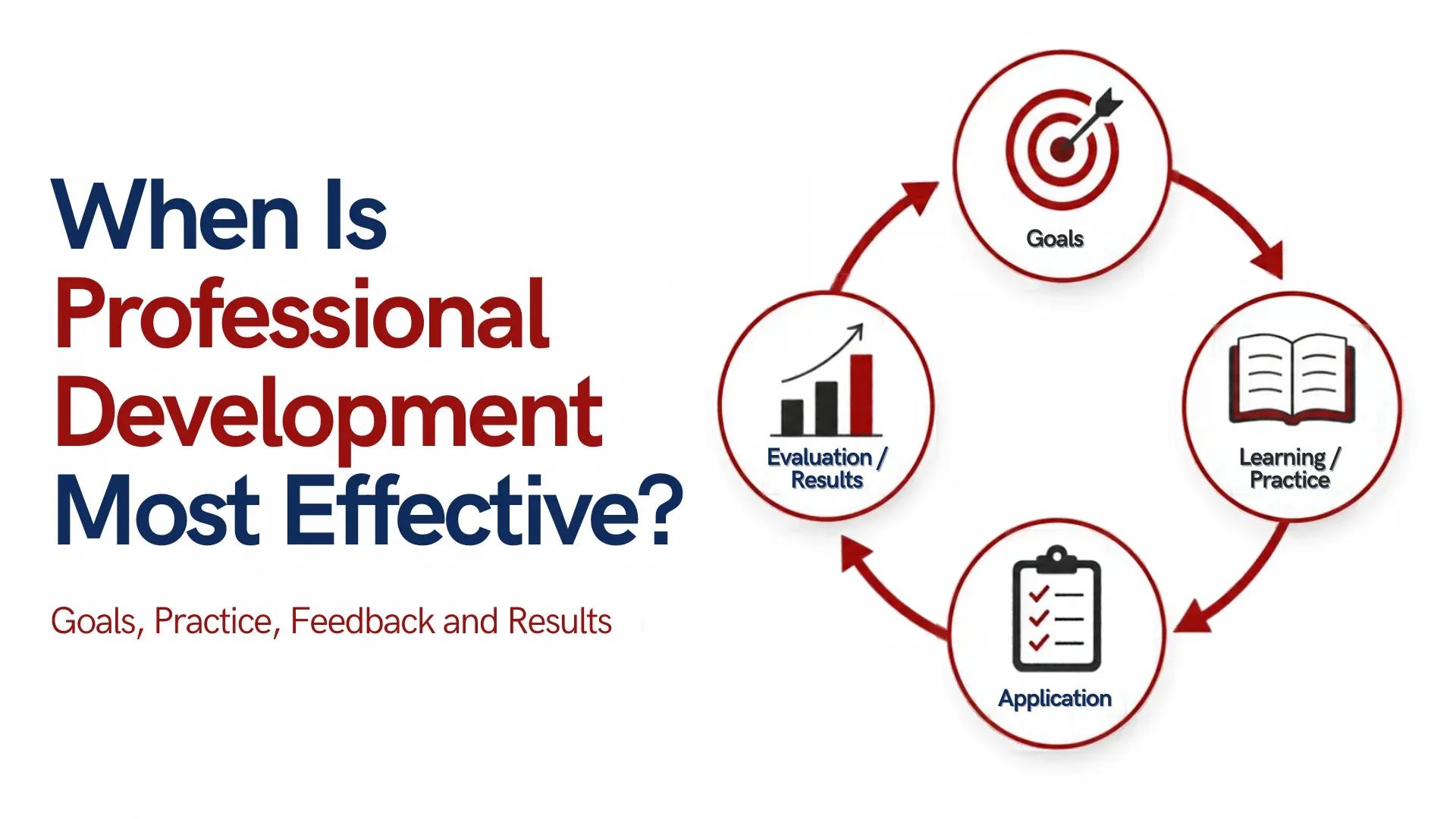
Effective professional development connects learning with a specific need and an opportunity to use the result. The learner should understand why the activity matters, what they are expected to gain and how the learning relates to their work. This creates a stronger purpose than completing training without a defined outcome.
The learning method must also suit the capability being developed. Reading may be appropriate for understanding a new concept, while coaching, observation or supervised practice may be more suitable for a practical skill. A combination of methods may be needed when the goal requires both knowledge and workplace application.
Professional development is more likely to succeed when it includes:
- A clearly identified learning need
- Specific and realistic development goals
- Content relevant to the learner’s work
- Active participation and practical application
- Time to practise new knowledge or skills
- Feedback from an appropriate person
- Support from an employer or manager where needed
- Reflection on what changed
- A method for reviewing the outcome
- Further learning when the original need has not been fully addressed
These elements do not need to appear in exactly the same way in every activity. A short update may require less planning than a long development programme. The principle remains the same: the activity should have a purpose, support relevant learning and lead to an outcome that can be reviewed.
Professional Development Should Have Clear Goals
A clear goal gives professional development direction. It helps the learner decide what type of activity is suitable and provides a basis for evaluating the result. Without a goal, it is easy to choose training that sounds useful but does not address an actual development need.
Goals should describe what the learner wants to understand, improve or perform. “Improve communication skills” is broad and difficult to measure. “Deliver clearer project updates that explain risks, decisions and next steps” identifies a particular area of communication and creates opportunities to review progress.
A development goal can relate to a current responsibility, a known skills gap or a future career aim. It should be challenging enough to produce meaningful learning but realistic enough to apply within the learner’s circumstances. Large goals can be divided into smaller objectives so progress is easier to recognise.
Professional Development Should Be Relevant
Relevant professional development connects directly to the learner’s role, responsibilities or planned direction. People are more likely to engage with learning when they understand how it will help them solve a problem, improve a task or prepare for a realistic opportunity. Relevance also makes it easier to apply the learning soon after the activity.
The same course may be valuable for one person and unnecessary for another. A new manager may benefit from structured learning about delegation, while an experienced manager may need targeted development in a more complex area. The title of an activity is therefore less important than its relationship to the learner’s needs.
Before choosing an activity, the learner should review its subject, intended audience and learning outcomes. They should also consider whether it matches their existing level of knowledge. Training that is too basic may add little value, while advanced material may be difficult to use without the necessary foundation.
Active Learning and Practical Application
Professional development is often more effective when learners actively engage with the subject. Discussion, problem-solving, practice and workplace tasks require the learner to use information rather than only receive it. Active participation can also reveal misunderstandings that may remain hidden during passive learning.
Practical application helps turn knowledge into capability. Someone may understand a method during a course but still need repeated practice before they can use it confidently. Applying the learning in a relevant setting shows which parts are useful and which parts require further explanation or adjustment.
For example, a course may introduce a manager to a new approach for giving feedback. The manager would then need to use that approach in appropriate conversations, observe the response and review what could be improved. The course begins the development, while practice helps establish the skill.
Professional Development Should Be Continuous
Professional development is most effective when it forms part of an ongoing process rather than an isolated event. Work changes over time, and one activity cannot prepare someone for every future responsibility. Regular review helps learners keep their knowledge current and respond to new development needs.
Continuous development does not mean completing courses without a break. It means recognising that learning, application and reflection repeat throughout a career. A person may complete an intensive activity, spend several months applying it and then decide what further development is needed.
Continuing Professional Development provides a structured way to manage this process. CPD may include formal courses, workplace learning, mentoring, professional reading and reflection. Our guide to what CPD means explains these different forms of learning in greater detail.
Reflection and Feedback Improve Professional Development
Reflection helps learners examine what they gained from an activity and how it affected their work. It moves the focus beyond completion and asks whether the learning improved understanding, behaviour or professional practice. Reflection may also show that an activity did not fully address the original need.
Useful reflection considers what was learned, where it was applied and what happened as a result. The learner can compare the outcome with the goal set before the activity. They can then decide whether to continue practising, seek feedback or choose another form of development.
Feedback adds another perspective. A manager, mentor, colleague or supervisor may notice changes the learner cannot easily assess alone. Feedback should relate to the development goal and provide enough detail to guide improvement rather than offering only general praise or criticism.
Support From Employers and Managers
Workplace professional development is more effective when employees receive appropriate support. This may include time for learning, access to relevant resources, mentoring or an opportunity to practise a new skill. Support should reflect the development need rather than assume that every employee requires the same course.
Managers can help employees define realistic goals and connect development with suitable work. They can also discuss progress, provide feedback and remove practical barriers where possible. These actions show that learning is part of professional practice rather than an activity separate from work.
Employer support does not remove the learner’s responsibility. Employees should engage with the activity, apply the learning and explain where further support is needed. Effective development usually involves shared responsibility between the learner and the organisation.
Time and Opportunity to Apply New Skills
Learning may fade if it is not used. A person who completes training but has no opportunity to apply it may remember the general ideas without developing practical competence. Professional development should therefore be timed so that relevant practice is reasonably available.
Application does not always need to involve a large or high-risk task. The learner might begin with a supervised activity, a simulation or a smaller responsibility. As their ability develops, they can move towards more independent or complex work.
Enough time must also be allowed for improvement. Some knowledge can be applied quickly, while judgement, leadership and technical skills may develop gradually. Evaluating an activity immediately after completion may capture satisfaction or understanding, but it may be too early to judge its effect on professional practice.
How to Measure Professional Development Effectiveness
Professional development effectiveness should be measured against the original learning need and goal. The most useful evidence depends on what the activity was intended to achieve. A test may demonstrate knowledge, while observation or completed work may provide stronger evidence of a practical skill.
Possible measures include:
- Improved understanding of a subject
- Successful completion of a relevant task
- Greater consistency or accuracy at work
- Increased confidence with a defined responsibility
- Feedback from a manager, mentor or colleague
- Fewer avoidable mistakes
- Better quality of work
- Readiness to handle a wider responsibility
- A change in professional behaviour or judgement
- Progress towards a career or development goal
Learner satisfaction can be considered, but enjoyment alone does not prove effectiveness. A session may be interesting without producing a useful change, while challenging learning may prove highly valuable after it is applied. Evaluation should focus on whether the intended outcome was achieved.
It may be helpful to review development at more than one point. An immediate review can check understanding, while a later review can examine application and longer-term progress. This produces a more complete picture than asking only whether the learner enjoyed the activity.
Common Reasons Professional Development Is Ineffective
Professional development can be ineffective when the activity has no clear connection to the learner’s needs. Mandatory training selected for an entire workforce may contain relevant material for some employees but repeat knowledge for others. A lack of relevance can reduce attention and make practical application difficult.
Unclear goals are another common problem. If neither the learner nor the employer can explain what should improve, they cannot select the most suitable activity or measure its result. The development may then be judged by attendance because no meaningful outcome was established.
Other common barriers include:
- Selecting learning before identifying the skills gap
- Using the same approach for every learner
- Choosing content at the wrong level
- Providing information without active participation
- Allowing no time to practise
- Failing to provide feedback
- Treating a certificate as proof of competence
- Measuring satisfaction instead of workplace outcomes
- Providing no follow-up after training
- Completing activities only to meet an hours target
Recognising these barriers does not mean every activity needs a complicated evaluation process. A brief activity may require only a simple goal and review. More significant development should receive a level of planning and evaluation that reflects its cost, duration and intended impact.
How to Make CPD More Effective
Effective CPD begins with identifying what needs to change. The learner can review their responsibilities, recent feedback, professional requirements and future goals. This helps them distinguish a genuine development priority from a subject that is merely interesting.
A practical process may include:
- Identify the development need.
- Describe the desired outcome.
- Choose an activity that matches the learner and goal.
- Decide how the learning will be applied.
- Complete the activity and retain suitable evidence.
- Practise the knowledge or skill.
- Seek relevant feedback.
- Reflect on the result.
- Review whether the original goal was achieved.
- Choose the next development priority.
The process should remain flexible. If an activity does not produce the intended result, the learner may need more practice, a different learning method or a revised goal. Development remains effective when evaluation leads to a better next step rather than being treated as a final judgement.
Articles and Resources About Professional Development
Articles about professional development are useful when they answer a specific question or support a defined learning need. General reading can introduce ideas, while focused guidance can help someone plan an activity, understand CPD or improve how they record development. Reading becomes more valuable when the information is considered and applied rather than saved without further action.
Our guide to professional development explains its meaning, benefits and common forms. The article on why CPD is important examines its value for careers and workplaces. Readers who need a broader introduction can also review our guide explaining what CPD means.
A resource should be assessed for relevance, clarity and currency before it influences professional practice. Where a regulator, professional body or employer sets specific requirements, its current rules should take priority. General articles can support understanding, but they do not replace requirements that apply to a particular profession.
Summary
Professional development is most effective when it has a clear goal, addresses a relevant learning need and includes an opportunity for practical application. The learning method should match the capability being developed and the learner’s existing knowledge. Active participation, suitable support and enough time to practise can strengthen the outcome.
Reflection and feedback help determine whether learning has produced a meaningful change. Effectiveness should be measured through relevant knowledge, behaviour, work or professional outcomes rather than attendance alone. Reviewing development immediately and again after practical application can provide a more accurate assessment.
Professional development should also form part of a continuing process. Learners can use each outcome to identify their next priority and select further development when needed. This approach turns separate learning activities into sustained professional growth.
Frequently asked questions
When is professional development most effective?
Professional development is most effective when it addresses a specific need, has a clear goal and can be applied in practice. Feedback, reflection and follow-up help the learner understand whether the activity produced the intended result. The learning method should also suit the person’s experience and the capability being developed.
What makes professional development effective?
Clear goals, relevant content, active participation and practical application are central to effective professional development. Learners also need enough time and support to use their new knowledge or skills. The outcome should be evaluated against the original development need.
Why are professional development goals important?
Goals clarify what the learner wants to improve and help them choose a suitable activity. They also provide a basis for measuring progress after the learning has been applied. Without a goal, development may be completed without producing a relevant outcome.
Why should professional development be continuous?
Professional knowledge and workplace expectations change over time. Continuous development helps people maintain their capabilities and respond to new responsibilities. It also allows one learning outcome to inform the next development priority.
How does reflection improve professional development?
Reflection helps learners examine what they learned, how they applied it and what changed as a result. It can identify progress as well as areas that still need attention. This makes future development choices more focused.
Why is practical application important?
Application turns information into usable knowledge or skill. It reveals whether the learner can use what they learned in a relevant situation. Practice also provides evidence that can be reviewed through reflection and feedback.
How can employers support effective professional development?
Employers can help identify relevant needs, provide suitable learning opportunities and allow time for application. Managers can offer feedback and connect learning with real responsibilities. Support should be appropriate to the employee’s role, experience and development goal.
How do you measure professional development effectiveness?
Measure effectiveness against the original goal. Evidence may include improved knowledge, successful task completion, better work quality, changed behaviour or relevant feedback. The measure should reflect what the development was intended to achieve.
What makes CPD effective?
CPD is effective when it is relevant, purposeful and connected to professional practice. The learner should apply the learning, reflect on the result and record an accurate outcome. Completing activities or hours without considering their effect provides limited evidence of development.
What are common barriers to effective professional development?
Common barriers include unclear goals, irrelevant training, insufficient practice, lack of feedback and no follow-up. Development may also be ineffective when its level or format does not suit the learner. Identifying the need before selecting an activity can prevent many of these problems.