

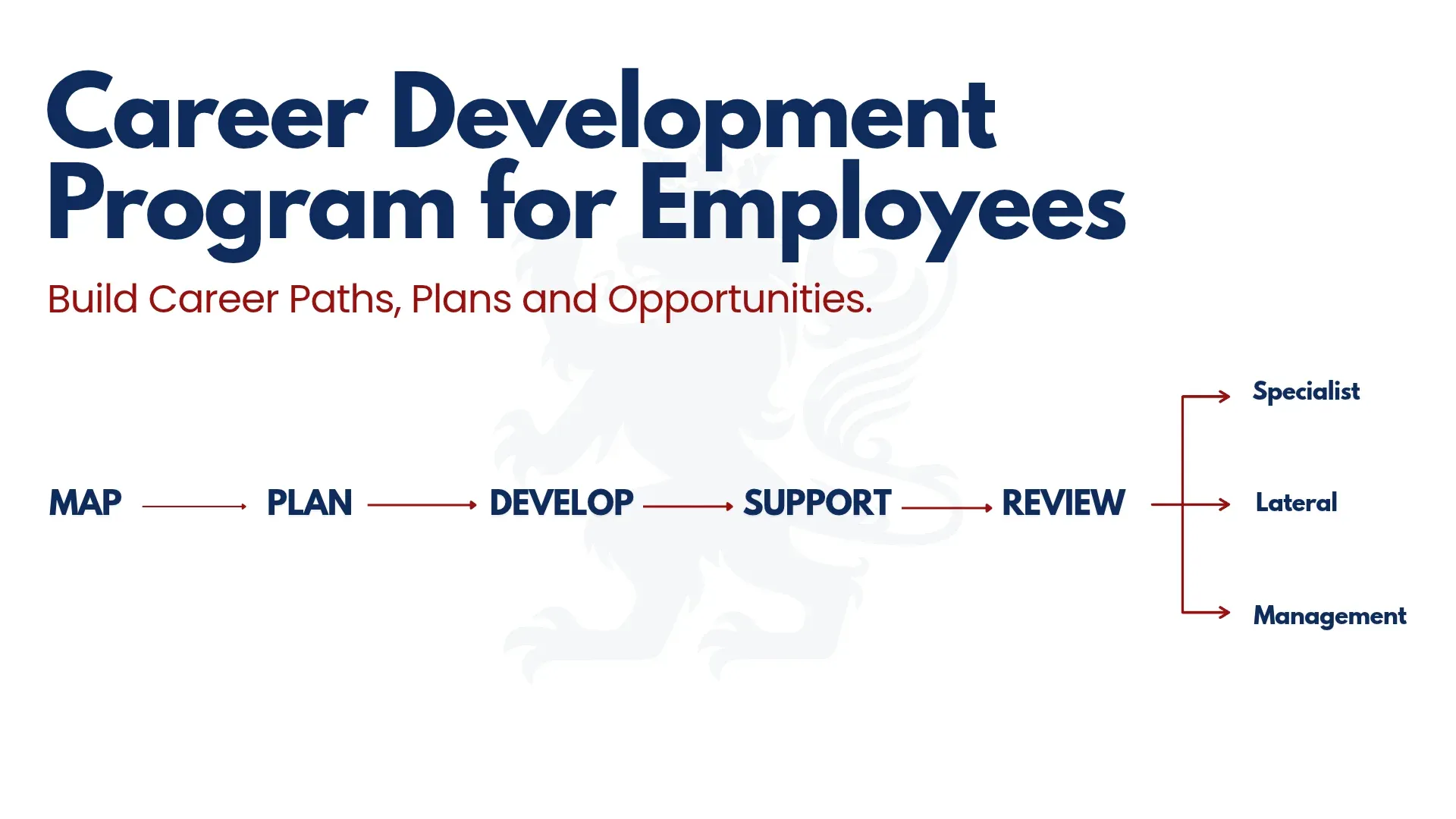
A career development program gives employees a structured way to explore possible career paths, understand what different roles require and prepare for suitable future opportunities. For employers, it can connect staff development with capability needs, internal mobility and workforce planning.
A useful programme does more than provide a collection of courses. It combines clear career information, individual development planning, workplace experience, manager support and relevant learning opportunities.
This guide explains how employers can design, deliver and review a career development program for employees without implying that participation guarantees promotion.
What Is a Career Development Program?
A career development program is a structured organisational approach to helping employees plan and prepare for possible career directions.
The programme may include career pathways, skills frameworks, development conversations, mentoring, job shadowing, workplace projects, role rotations and formal learning. These elements should work together rather than operate as unrelated benefits.
In UK English, “career development programme” is the more common spelling. “Career development program” is widely used internationally. Both expressions refer to the same general concept.
The programme should provide enough information for employees to understand their options while recognising that no employer can promise a particular role. Available opportunities depend on organisational needs, vacancies, performance and the requirements of individual positions.
For an employee-focused explanation, see our guide to what career development means.
Career Development Program vs Employee Development Plan
A career development program belongs to the organisation. It establishes the systems, resources and opportunities available to employees.
An employee career development plan belongs to an individual. It records the employee’s possible direction, development needs, actions and review points.
The programme creates the environment in which individual plans can operate. For example, the employer might publish career pathways, provide mentoring and offer short-term projects. An employee’s plan then identifies which of those opportunities is relevant to their goals.
One organisational programme may support hundreds of different employee plans. It should provide structure without forcing every employee towards the same career destination.
Career Development vs Training
Training is one possible part of a career development program, but the two are not interchangeable.
Training usually addresses a defined area of knowledge or skill. Career development considers broader questions about future roles, experience, professional direction and readiness.
An employee preparing for supervision may complete management training. They may also need to observe an experienced manager, lead a small project, practise giving feedback and discuss their progress with a line manager.
Providing a library of online courses does not by itself create an employee career development program. The learning needs to connect with career paths, role requirements and opportunities to gain relevant experience.
Why Create a Career Development Program?
Employers may create a career development program to make career opportunities and role expectations clearer.
Without an organised approach, employees may not know which roles exist, what skills they require or how to gain relevant experience. Development opportunities can then depend heavily on informal relationships or whether an individual manager happens to prioritise career discussions.
A structured programme can help an organisation:
- Explain possible career paths
- Make role expectations clearer
- Identify capability gaps
- Connect learning with future workforce needs
- Support internal mobility
- Prepare employees for broader responsibilities
- Make development opportunities easier to find
- Improve the quality of career conversations
- Build evidence for workforce and succession planning
These are potential benefits rather than guaranteed outcomes. A programme must be used consistently and supported by real opportunities if it is to influence employee development.
Start With Organisational Needs
A career development program should not begin with a list of courses. It should begin with an understanding of the organisation’s workforce.
Review the roles and capabilities the organisation currently needs, as well as those it may need in the future. Consider growth plans, expected vacancies, changing technology, specialist shortages and areas where too much knowledge depends on one person.
This does not mean that employee aspirations must be limited to the organisation’s immediate vacancies. It means the employer should be honest about where it can provide opportunities and where an employee may eventually need to look elsewhere.
The analysis may reveal several priorities. One department might need stronger technical expertise, while another needs people prepared for first-line management. The career development programme can then provide different pathways rather than one standard solution.
Define the Purpose and Scope
The purpose of the programme should be clear before its design begins.
An organisation might want to improve internal mobility, make career paths more transparent or prepare employees for specialist and management roles. A smaller employer may focus on better career conversations and access to cross-functional experience.
Define who can use the programme. It may cover the entire workforce, a particular profession, employees at specific career stages or people working within one job family.
A narrow pilot can be appropriate, but the eligibility criteria should be explained. Employees need to understand whether the programme is generally available, targeted at a particular workforce need or part of a separate talent-management process.
Career development should not automatically be treated as the same thing as a high-potential programme. Employees who are not being prepared for senior leadership may still need meaningful opportunities to deepen expertise or move across functions.
Build Career Pathways
A career pathway shows how roles or areas of work relate to one another. It helps employees explore possible moves and understand what different positions require.
The UK government’s HR Career Framework describes a career pathway as a series of connected roles, often at different levels. It also recognises that individual paths may be linear, non-linear or move across job families.
An organisational pathway might show:
- Entry and experienced roles
- Specialist and management routes
- Possible lateral moves
- Typical responsibilities at each level
- Relevant knowledge and skills
- Experience normally expected
- Mandatory qualifications or registrations
- Possible learning and workplace opportunities
The pathway should not suggest that progression happens automatically after a fixed period. It provides information about possible routes and expectations, not a promise of promotion.
Create a Career Framework
A career framework provides more detail than a simple organisational chart. It explains job families, role levels and the capabilities associated with them.
A useful framework can help employees compare their current role with possible future positions. Managers can also use it to structure development conversations and identify relevant learning.
The Government Finance Function Career Framework demonstrates how a framework can define job families, expected skills, experience and qualifications while connecting employees with learning resources.
When creating a framework, avoid making every career appear vertical. Include specialist, lateral and cross-functional routes where they genuinely exist.
Role descriptions should remain accurate and current. If the framework bears little resemblance to how recruitment and progression decisions are actually made, employees will quickly stop trusting it.
How to Create a Career Development Program
A practical design process can be organised into nine stages.
1. Assess workforce priorities
Identify current and future roles, capability gaps and areas where the organisation needs stronger internal pipelines.
Use workforce information alongside discussions with department leaders and employees. Historical promotion patterns alone may not represent future needs.
2. Map job families and career paths
Group related roles and identify realistic movements between them. Include technical, specialist, management and cross-functional routes where appropriate.
Clarify which moves represent potential pathways rather than guaranteed sequences.
3. Define role requirements
Explain the knowledge, skills, experience and qualifications associated with each role or level.
Separate mandatory requirements from capabilities employees can develop after entering the role. This prevents employees from spending time on learning that cannot satisfy a formal requirement.
4. Establish development planning
Provide a consistent format for employee career development plans.
The plan should capture possible career directions, current strengths, development needs, actions, support and review dates. It should remain flexible enough to change when the employee’s interests or circumstances change.
5. Prepare managers
Managers need guidance on discussing career interests, providing realistic feedback and identifying suitable opportunities.
They should not promise roles or imply that completing a development plan guarantees promotion. Their role is to help employees understand options, assess needs and access appropriate support.
6. Offer varied development opportunities
Combine formal learning with mentoring, workplace projects, job shadowing, role rotation and other relevant experiences.
Different career goals require different forms of development. A technical specialist and an aspiring team manager should not be given identical programmes.
7. Communicate the programme
Explain who can participate, what support is available and how decisions are made.
Employees should understand the difference between career development, performance management, succession planning and competitive recruitment.
8. Launch and monitor delivery
A pilot can help the organisation identify confusing guidance, manager-support needs and gaps in the available opportunities.
Gather feedback from employees and managers without relying solely on satisfaction ratings.
9. Review and improve
Compare the programme with its original purpose. Examine access, participation, development activity and relevant workforce outcomes.
Update career pathways and role requirements when the organisation changes.
How to Create a Career Development Plan for Employees
An employee career development plan should convert a general career interest into practical next steps.
Begin with a possible direction. This might be a role, specialist field, broader responsibility or area the employee wants to explore.
Next, compare the employee’s current evidence with the requirements of that direction. The comparison should consider experience and workplace performance as well as courses or qualifications.
The plan can then record:
- The employee’s career interest
- Relevant strengths and experience
- Capabilities or evidence to develop
- Development actions
- Workplace application opportunities
- Support required from the manager
- Timeframes and review dates
- Evidence that will show progress
The plan should distinguish career development from a promise of advancement. Completing every action may improve readiness, but recruitment, promotion and appointment decisions should follow the organisation’s normal processes.
Example of an Employee Career Growth Plan
Consider an experienced customer-service employee interested in becoming a team supervisor.
The organisation’s career framework shows that supervisors need experience in coordinating work, handling escalated concerns, giving feedback and monitoring service standards.
The employee already handles complex customer cases but has limited experience supporting colleagues. Their development plan could include shadowing a supervisor, leading one team briefing each month and assisting with a small service-improvement project.
They might also complete training on feedback conversations and apply the method during a supervised peer-support activity.
After four months, the employee and manager review the evidence. They discuss feedback from the briefings, the project outcome and areas that still need development.
The process gives the employee relevant experience and a clearer understanding of the role. It does not guarantee that they will receive a supervisory position.
Career Development Opportunities for Employees
A strong programme offers different ways to develop because career readiness is not built through formal courses alone.
Workplace projects
Projects allow employees to gain experience solving real organisational problems. The assignment should have clear boundaries, suitable support and a genuine learning purpose.
Mentoring
A mentor can help an employee explore career options, understand professional expectations and learn from relevant experience.
Mentoring should not become informal sponsorship available only to well-connected employees. The programme needs a transparent method of matching or accessing mentors.
Coaching
Coaching can address a defined behaviour or responsibility. It may help employees practise presentations, delegation, decision-making or career conversations.
Job shadowing
Shadowing allows an employee to observe how another role operates. A learning brief and follow-up discussion make the experience more useful than unstructured observation.
Role rotation
A temporary move can expose an employee to another department or job family. The purpose, duration and expected learning should be agreed before the rotation begins.
Stretch assignments
A stretch assignment gives an employee responsibility beyond their normal work while providing appropriate support. It should develop capability rather than simply increase workload.
Secondments
A secondment can provide deeper experience in another role, team or organisation. The arrangement should clarify responsibilities, supervision and what happens when it ends.
Formal learning and career advancement training
Courses can introduce knowledge required for future roles. Career advancement training may cover management, communication, technical subjects or another defined capability.
Training should be chosen because it addresses a documented need. An impressive course title does not guarantee career relevance.
Professional development and CPD
Professional development can support a career plan when it develops knowledge or skills connected to a possible future role.
For practical options, see our guide to professional development activities.
Online Career Development Courses
Online learning can make development more accessible across different locations and working patterns.
An online career development course might cover self-assessment, career planning, leadership preparation or a technical capability required for progression. Its value depends on whether the content matches the employee’s needs and leads to a relevant next step.
Employers should not rely on self-paced courses as the entire programme. Employees may also need discussion, workplace experience, feedback and access to accurate information about organisational opportunities.
Online learning should therefore sit within the wider career-development system rather than operate as an isolated course catalogue.
The Role of Managers
Managers influence whether career development exists in everyday work or only in organisational policy.
They can help employees understand role expectations, identify suitable development and find opportunities to apply new learning. They can also provide realistic feedback about current readiness.
Managers should avoid controlling every career decision. Employees may have interests outside the manager’s department or beyond the organisation.
Useful manager responsibilities include:
- Holding regular career conversations
- Listening to employee interests
- Providing evidence-based feedback
- Explaining available opportunities
- Supporting appropriate development actions
- Reviewing progress
- Avoiding unsupported promises
- Referring employees to specialist guidance where needed
Managers need time, information and guidance to perform this role consistently.
The Role of Employees
Employees should participate actively rather than wait for the organisation to design every step.
They can research possible paths, prepare for career conversations and take responsibility for agreed actions. They should also explain when their interests or circumstances change.
Employees need to keep claims about their readiness accurate. Completing a course may build knowledge but does not automatically demonstrate the experience or judgement required for a role.
The programme should encourage ownership without implying that career outcomes depend entirely on personal effort. Access to opportunities, organisational decisions and external conditions also affect progression.
Making Career Development Opportunities Accessible
A programme can appear open while remaining difficult to access in practice.
Review who receives mentoring, stretch assignments, secondments and manager attention. Consider whether opportunities depend too heavily on informal networks, physical location or visibility to senior leaders.
Publish information about available opportunities and explain how employees can express interest. Where selection is necessary, use relevant and understandable criteria.
Include specialist and lateral pathways so that development does not appear to mean management alone. Employees with different working patterns, locations and career goals should be able to identify realistic options.
Accessibility does not mean promising identical outcomes. It means making information, processes and opportunities as clear and fair as reasonably possible.
Connecting Career Development With Workforce Planning
Employee development and career management should connect with the organisation’s future capability needs.
Workforce planning can identify roles that may become difficult to fill, emerging skill requirements and areas where succession is weak. Career development can then help employees explore relevant pathways and gain suitable experience.
The connection should not reduce employees to future vacancies. Individual interests still matter, and not every employee will want the roles the organisation needs.
A balanced programme identifies areas where employee aspirations and organisational requirements can support one another. Where they do not align, the organisation should communicate honestly rather than offer development that leads nowhere.
How to Measure a Career Development Program
Measurement should begin with the programme’s stated purpose. A programme designed to improve career-path visibility needs different measures from one intended to build a pipeline for specialist roles.
Possible measures include:
- Employee awareness of career pathways
- Participation across departments and employee groups
- Completion and review of career development plans
- Access to mentoring, projects and role rotations
- Manager participation in career conversations
- Movement between roles or departments
- Applications from internal candidates
- Development of capabilities linked to workforce needs
- Employee feedback about the clarity of available opportunities
- Retention within relevant roles or talent groups
These measures require careful interpretation. An increase in internal movement may be influenced by vacancies, recruitment policy or organisational growth as well as the career programme.
Participation is useful operational information, but it does not prove that the programme improved careers. Combine activity data with employee feedback, evidence of development and relevant workforce outcomes.
Practical Organisational Example
Consider a growing organisation that struggles to recruit team supervisors externally.
A review shows that experienced employees understand the work but have limited opportunities to practise delegation, feedback and team coordination. Employees also report that they do not understand how supervisors are selected.
The organisation creates a supervisor pathway describing the role’s responsibilities and expected capabilities. Employees can express interest during career conversations without being promised promotion.
Participants receive access to management workshops, supervisor shadowing and a supported team-improvement project. Managers review evidence from these activities using common guidance.
After the first cycle, the organisation reviews participation, employee feedback, completion of development activities and internal applications for vacant supervisor roles.
This example connects a workforce need with transparent role information and relevant experience. It does not bypass competitive selection or guarantee appointment.
Common Mistakes in Employee Career Development
One common mistake is presenting a course catalogue as a complete career development program. Employees need pathways, conversations and practical experience as well as training.
Another is designing the programme only for future managers. Specialist, lateral and cross-functional career routes may be equally valuable.
Employers may also publish career pathways that do not reflect real recruitment or progression decisions. This undermines trust in the programme.
Other mistakes include:
- Promising advancement after programme completion
- Giving managers responsibility without guidance
- Offering opportunities through informal networks
- Using the same development plan for every employee
- Confusing career development with performance correction
- Measuring enrolments without examining outcomes
- Failing to update role requirements
- Providing learning with no opportunity to apply it
A programme should remain realistic about what the employer can offer and what participation means.
How CPD Qualifications Fits Into Employee Development
CPD accreditation and career development programmes serve different purposes.
A career development programme is designed and managed by the employer. It identifies pathways, development needs, experiences and organisational support.
At CPD Qualifications, individual courses can be reviewed for CPD accreditation. The assessment considers the submitted learning activity, including its outcomes, materials, structure, completion evidence and claimed active learning time.
Provider Approval is a separate review of a training organisation and its operating processes. It does not mean that every course delivered by the provider is individually CPD accredited.
Accredited learning may contribute to an employee development plan when it addresses a relevant need. However, accreditation does not guarantee promotion, career advancement or acceptance under every professional scheme.
Employers and training providers can learn more about CPD course accreditation and the CPD review process.
Summary
A career development program gives employees a structured way to understand possible career paths, identify development needs and access relevant support. It should connect career frameworks, individual plans, manager conversations, workplace experience and formal learning.
An effective programme begins with organisational needs but leaves room for different employee goals. Career pathways should include specialist, lateral and management routes where these genuinely exist.
Employers should measure access, delivery and relevant workforce outcomes without treating participation as proof of advancement. The programme can improve preparation and career visibility, but it should never promise promotion.
Frequently asked questions
What is a career development program?
A career development program is an employer-led system that helps employees understand career paths, identify development needs and access relevant learning or experience.
What should an employee career development program include?
It may include career pathways, role requirements, individual development plans, manager conversations, mentoring, workplace projects, role rotation and formal learning.
How do you create a career development program for employees?
Assess workforce needs, map career paths, define role requirements, establish employee planning, prepare managers, provide development opportunities and measure relevant outcomes.
What is an employee career development plan?
It is an individual record of an employee’s career interests, current strengths, development needs, actions, support and review points.
Is a career development program the same as training?
No. Training is one possible component. A career programme also addresses pathways, experience, career conversations and workplace opportunities.
How can employers help employees with career development?
Employers can provide clear role information, career conversations, mentoring, learning, workplace experience and transparent access to internal opportunities.
What career development opportunities can employers offer?
Options include projects, mentoring, coaching, job shadowing, rotations, secondments, stretch assignments, formal courses and relevant CPD.
Does completing a career development program guarantee promotion?
No. Participation may improve preparation, but advancement depends on role requirements, performance, available opportunities and the organisation’s selection process.
How can an organisation improve career development?
It can make career pathways clearer, prepare managers, widen access to development experiences and connect employee plans with genuine organisational opportunities.
How should a career development program be measured?
Measures can include pathway awareness, participation, access to opportunities, manager engagement, internal movement and capabilities developed. Results should be interpreted alongside organisational context.
Can online courses support career advancement?
They can support relevant knowledge or skills, but an online course alone does not guarantee advancement. Workplace application and role requirements also matter.
What is the difference between career development and succession planning?
Career development supports employees in exploring and preparing for possible directions. Succession planning focuses more specifically on organisational continuity and potential candidates for important roles.