

The number of continuing education hours you need depends on your profession and the organisation responsible for your licence, registration, certification or professional membership. Some organisations set a fixed annual target, others measure learning across a multi-year reporting period, and some assess the relevance and outcomes of your development without requiring a particular number of hours.
Checking the total number is therefore only the beginning. Your rules may also specify mandatory subjects, acceptable learning formats, recognised course providers, evidence requirements and submission deadlines. Completing 20 hours of training will not necessarily satisfy a 20-hour requirement if part of the learning falls outside the accepted categories.
This guide explains how continuing education hours and contact hours work, how to calculate them and how to identify the requirements that apply to your profession.
How Many Hours of Continuing Education Do You Need?
Your required total could be expressed as continuing education hours, contact hours, CE credits, Continuing Education Units or CPD points. Although these terms are sometimes used as though they mean the same thing, their values depend on the system applying them.
One professional may need to complete a fixed number of hours every calendar year. Another may be given two or three years to accumulate a larger total. A third may have no numerical target at all but must demonstrate regular, relevant learning and explain how it has improved professional practice.
The most reliable place to find your requirement is the organisation that controls your professional status. Check its current renewal guidance and confirm:
- The number of hours or credits required
- The beginning and end of the reporting period
- Whether particular subjects are compulsory
- Which learning formats are accepted
- Whether a provider or course must be approved
- What evidence must be retained
- When and how completion must be reported
Do not rely on a colleague’s target simply because you have similar jobs. Requirements can differ according to professional category, registration status, location, speciality or renewal date.
What Are Continuing Education Contact Hours?
A continuing education contact hour represents a measured period during which a learner participates in an eligible educational activity. It is commonly used for courses, workshops, webinars, conferences and other organised professional learning.
The exact definition is controlled by the organisation awarding or accepting the hours. Under a common approach, one contact hour reflects approximately 60 minutes of instruction. However, some systems use 50-minute instructional periods, and others apply their own minimum attendance or participation rules.
Instructional time usually includes the parts of an activity that contribute directly to its learning outcomes. A two-hour workshop might contain 90 minutes of teaching, a 15-minute break and 15 minutes for registration and introductions. If only the instructional portion qualifies, the participant may receive 1.5 contact hours rather than two.
This is also where instructional hours fit into the calculation. An instructional hour describes scheduled teaching time, while a contact hour is the recognised credit awarded under the applicable framework. They can be equal, but that should never be assumed without checking the relevant rules.
What Does “CE Hours” Mean?
CE hours is a shortened form of continuing education hours. It usually refers to time spent completing recognised learning after a person has entered a profession or earned an initial qualification.
The term alone does not confirm what will count towards a licence or registration. A course may advertise five CE hours, for example, but a professional body might accept only courses covering particular subjects or delivered by approved providers. The advertised duration and the credit recognised by your regulator are related, but they are not always identical.
Before booking a course, look beyond the number displayed on the certificate. Confirm who awards the hours, what calculation method is used and whether the receiving organisation recognises them.
Continuing Education Hours vs Contact Hours
Continuing education hours is a broad expression for the time credited to professional learning. Contact hours are a more specific measure of direct participation in an organised educational activity.
A professional may spend additional time reading preparatory material, completing an assessment or reflecting on the lesson. Whether that time is included depends on the framework. Some systems count only direct instructional contact, while others recognise a wider range of guided or self-directed learning.
For example, imagine a learner attends a three-hour webinar, including a 15-minute break, and later spends one hour applying the lesson in the workplace. A contact-hour system may recognise only two hours and 45 minutes of instruction. A broader CPD framework might also recognise the follow-up activity if it has a genuine learning purpose and is properly recorded.
The practical lesson is simple: record the duration of each element rather than combining the entire experience into one estimated total.
How Many Contact Hours Equal One CEU?
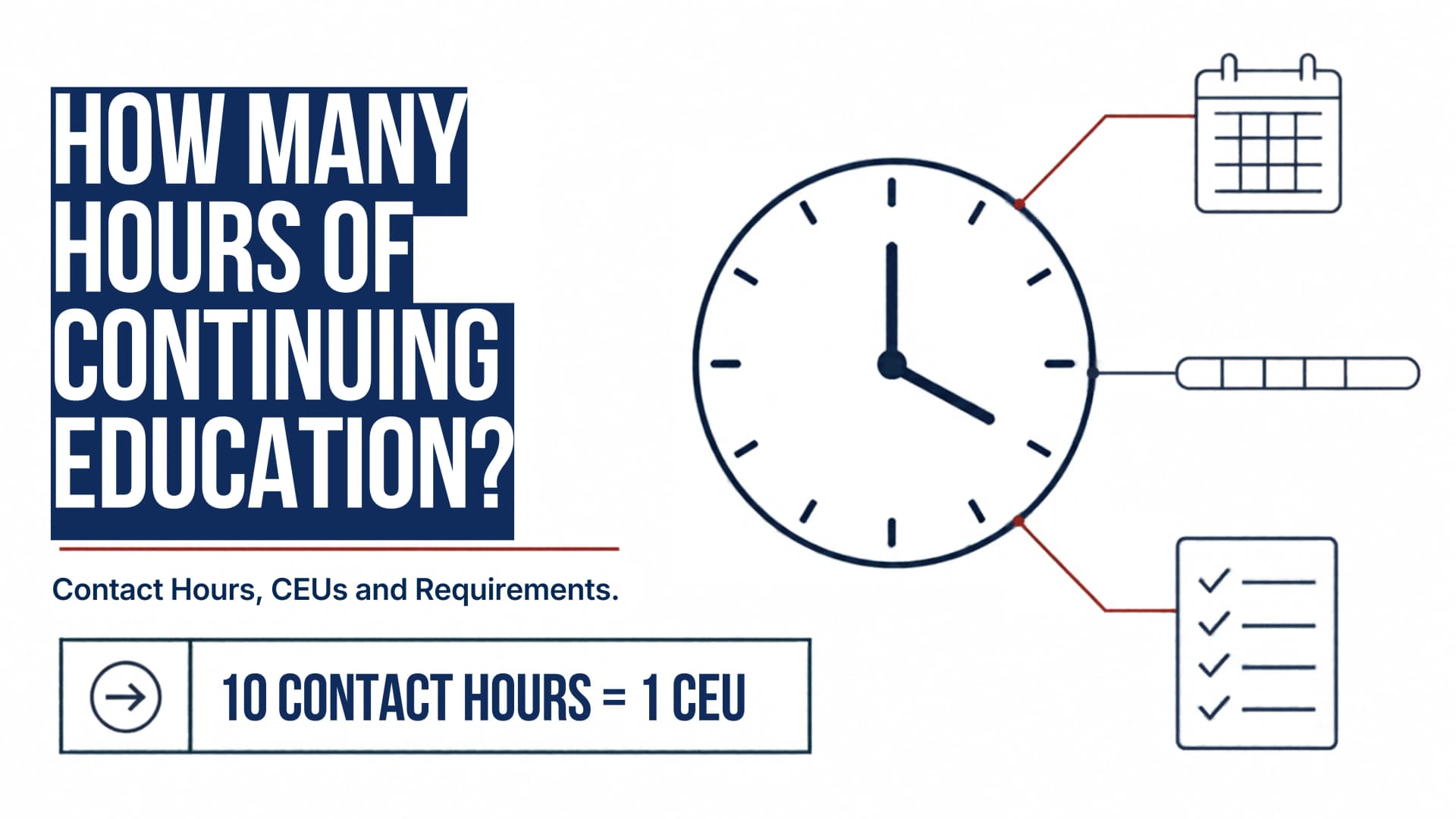
Under the widely used ten-hour model, 10 eligible contact hours equal one Continuing Education Unit:
1 contact hour equals 0.1 CEU.
5 contact hours equal 0.5 CEU.
10 contact hours equal 1 CEU.
12 contact hours equal 1.2 CEUs.
This conversion is supported by Head Start’s official professional development guidance, which describes one CEU as 10 contact hours of participation in an organised continuing education or training experience.
These figures show the mathematical conversion under that model; they do not guarantee that every organisation will award or accept the resulting credit. Some professional systems do not use CEUs, and others apply additional approval, assessment, attendance or reporting conditions.
If a course contains 6.5 eligible contact hours, the basic calculation produces 0.65 CEU. The final figure shown on a certificate may be affected by the awarding organisation’s rules on decimal precision and rounding.
For a fuller explanation of the terminology, see our guide to the definition of Continuing Education Units.
How Are Continuing Education Hours Calculated?
Start with the time allocated to eligible learning and remove any periods that do not count. Registration, meal breaks, networking sessions, commercial presentations and general event administration are commonly excluded unless the relevant framework states otherwise.
Suppose a course runs from 9:00 am to 4:30 pm. It includes a 30-minute lunch, two 15-minute breaks and 30 minutes of registration and announcements. The event lasts seven and a half hours, but the eligible instructional time is six hours. Under an hour-for-hour system, the learner could therefore receive six continuing education hours.
The calculation becomes more complex when a programme combines live teaching, self-study and assessment. A provider might award credit for all three components if each one is structured, measurable and connected to the learning outcomes. Another organisation may recognise only the supervised teaching period.
For accurate calculation:
- Identify the scheduled learning components.
- Remove breaks and non-educational activities.
- Check whether independent study and assessments qualify.
- Apply the required unit or credit conversion.
- Follow the applicable rounding rules.
- Retain evidence showing how the result was reached.
Professionals should use the value formally awarded by the provider when it is recognised by their regulator. They should not increase the figure based on travel, informal conversation or additional time spent at the venue.
Calculating Hours for Online Courses and Webinars
Online learning can count towards continuing education, but being logged in is not always enough. Recognition may depend on meaningful participation, completion of required modules, attendance monitoring or a passing assessment.
For a live webinar, eligible time normally relates to the teaching session rather than the entire calendar booking. A webinar scheduled for two hours but containing a 15-minute break may provide only one hour and 45 minutes of eligible learning.
A self-paced course requires a different approach. The provider may assign a credit value after reviewing the course content, expected study time and assessment. An individual learner should not normally award themselves more credit simply because they took longer than the estimated duration.
Online courses may use attendance checks, timed modules, knowledge tests or completion tracking to support the awarded hours. Keep the certificate and, where available, the course description or transcript showing the learning outcomes and duration.
Examples of Continuing Education Requirements
Real professional requirements demonstrate why a single answer cannot apply to everyone. Some regulators set a clear numerical target, while others focus on relevance, records and the results of learning.
Doctors registered with the GMC
The UK General Medical Council requires doctors to undertake CPD activities every year. However, it does not impose a universal number of CPD points for revalidation. The GMC expects a doctor’s learning to reflect their scope of practice, professional responsibilities and development needs.
This means that collecting an arbitrary number of points is not the objective. Doctors must select meaningful activities and discuss relevant learning through the appraisal and revalidation process. The GMC’s official CPD guidance explains this outcomes-focused approach.
Professionals registered with the HCPC
The Health and Care Professions Council regulates several health and care professions. Its registrants must maintain a continuous and accurate CPD record, use a mixture of relevant learning activities and show how their development supports their practice and service users.
The HCPC does not set a fixed number of hours or points. Its emphasis is on the relevance and impact of learning rather than reaching a general numerical target. Registrants selected for audit may need to submit a supported written profile demonstrating that they meet the standards. The complete requirements are available in the HCPC standards of continuing professional development.
Veterinary surgeons and veterinary nurses
The Royal College of Veterinary Surgeons uses a numerical annual requirement alongside reflection. Veterinary surgeons on the practising register must complete 35 hours of CPD per calendar year, while registered veterinary nurses must complete 15 hours. Activities must also be recorded and reflected upon.
The RCVS does not allow unused hours to be carried into the following year. Its current requirements and information about possible pauses or exemptions are explained on the RCVS continuing professional development page.
These examples illustrate three different systems: annual learning without a universal points target, outcome-based standards without fixed hours and a specific annual hourly requirement. They also show why professionals should verify their own rules instead of adopting a general target found online.
Annual and Multi-Year Reporting Periods
A requirement described as “annual” normally applies within a defined 12-month period, but that period may be a calendar year, membership year or individual renewal cycle. Completing the necessary hours after the deadline may not correct an earlier shortfall unless the organisation provides a formal grace period.
Multi-year systems allow learning to be accumulated over a longer cycle. A requirement of 60 hours across three years does not automatically mean that exactly 20 hours must be completed each year. However, leaving all 60 hours until the final months creates unnecessary risk and may conflict with expectations for continuous development.
Requirements can also change during a reporting cycle. A regulator may introduce a mandatory topic, revise accepted learning formats or change its evidence rules. Check the current guidance periodically rather than relying only on the information you received at the beginning of the cycle.
What Activities Count Towards Continuing Education Hours?
Recognised activities often include structured courses, workshops, seminars, conferences and live webinars. Depending on the professional framework, relevant workplace learning, peer discussion, research, mentoring, teaching, reflective practice and self-directed study may also qualify.
An activity is more likely to be accepted when it has a clear professional purpose, defined learning outcomes and reliable evidence. Simply spending time on a work-related subject does not automatically make the activity eligible.
Consider a nurse who attends a two-hour session on updated infection-control procedures. If the subject relates to the nurse’s practice, the learning is structured and attendance is documented, it may be suitable for professional development. Watching an unrelated general-interest video for the same length of time would not carry the same professional relevance.
Before starting an activity, ask whether it addresses a genuine learning need, falls within the accepted categories and can be supported with appropriate evidence.
Do Online Courses Count Towards Continuing Education?
Online courses can count when they meet the same professional and educational standards applied to other learning formats. The relevant question is not simply whether a course is online, but whether the organisation reviewing your record will recognise its subject, provider, structure and evidence.
Check whether your regulator restricts the number of hours that may be earned through independent or distance learning. Some organisations accept a fully online programme, while others require part of the total to involve live instruction, interaction, practical work or a particular mandatory subject.
A legitimate certificate should normally identify the learner, course title, completion date, provider and awarded hours or credits. Where the certificate does not provide enough detail, retain the course outline and assessment result as supporting evidence.
CE Hours, CEUs and CPD Points Are Not Automatically Interchangeable
Continuing education hours measure eligible learning time. A CEU is a separate unit that is commonly based on 10 contact hours. CPD points are assigned under professional development systems that may or may not use an hour-for-point calculation.
For example, 10 contact hours may equal one CEU under the ten-hour model, while a CPD framework might award 10 points, five points or another value for the same activity. Some outcomes-based frameworks may not attach points at all.
Convert one measure into another only when the receiving organisation publishes an accepted conversion. A training provider’s certificate does not have the authority to determine how every regulator will interpret the learning.
Our CPD points guide explains how points, credits and learning hours operate within different professional development systems.
How to Record Continuing Education Hours
Create a record as soon as an activity is completed. Delaying the entry makes it easier to forget the exact duration, learning outcome or location of the supporting evidence.
A useful record includes the activity title, provider, completion date, eligible hours or credits, learning format and a short explanation of what was learned. Where reflection is required, note how the activity affected your knowledge, decisions or professional practice.
Keep certificates, attendance confirmations, transcripts, assessment results and relevant course descriptions together. A certificate proves completion, but it may not always demonstrate why the learning was professionally relevant. A short reflective note can provide this missing context.
Do not assume the provider will retain your records indefinitely. Evidence should remain accessible for at least the period specified by the organisation that may audit or review it.
What Happens If You Do Not Complete the Required Hours?
The consequences depend on the rules governing your professional status. A shortfall could lead to a request for additional evidence, a corrective learning plan, delayed renewal, loss of membership benefits or action affecting registration or certification.
Contact the relevant organisation as soon as you realise that you may not meet the requirement. Waiting until an audit or renewal deadline can reduce the options available. Some bodies provide extensions, approved pauses, exemptions or alternative arrangements for illness, parental leave and other exceptional circumstances, but these measures are not automatic.
Never alter dates, inflate durations or claim attendance that cannot be supported. An honest shortfall handled through the proper process is less serious than submitting an inaccurate professional record.
Common Mistakes When Counting Continuing Education Hours
One common mistake is recording the total event duration rather than the eligible teaching time. Lunches, breaks, registration and networking may need to be removed from the calculation.
Another is assuming that every course carrying a certificate will be accepted. A certificate confirms what the provider awarded; it does not guarantee recognition by a regulator or licensing authority.
Professionals may also confuse hours, CEUs and CPD points or apply a ten-to-one conversion in a system that does not use it. Other problems include missing mandatory subjects, completing too many hours in a restricted category and failing to retain evidence.
The safest approach is to check the requirements first, choose suitable learning second and record the activity immediately after completion.
How to Plan Your Continuing Education
Start by confirming the deadline and dividing any numerical target into manageable periods. Someone requiring 24 hours each year could aim for approximately six hours per quarter instead of trying to complete everything near the renewal date.
Select activities based on professional needs rather than convenience alone. If recent feedback has identified a weakness in communication, record-keeping or technical practice, prioritise learning that addresses that need. This produces a more credible professional record than completing unrelated courses simply to accumulate hours.
Review your progress periodically and leave enough time to address missing subjects or evidence. A simple check every three months can prevent a minor oversight from becoming a renewal problem.
Summary
There is no standard answer to how many hours of continuing education every professional needs. Requirements may involve a fixed annual total, a multi-year credit target or an outcomes-based process without a prescribed number. The GMC and HCPC focus on regular, relevant development rather than a universal points or hours target, while the RCVS requires 35 hours annually for veterinary surgeons and 15 hours for veterinary nurses.
Contact hours generally represent eligible instructional time, and under the commonly used CEU model, 10 contact hours equal one CEU. However, breaks and non-educational activities may be excluded, and not every organisation uses the same calculation. Confirm your current rules before enrolling, record eligible learning accurately and retain evidence that demonstrates both completion and professional relevance.
Frequently asked questions
How many hours of continuing education do you need?
The number depends on your profession, licence, certification and reporting period. There is no universal annual requirement. Check the current rules issued by the organisation responsible for your renewal or professional status.
What are continuing education contact hours?
Continuing education contact hours measure eligible participation in an organised learning activity. They may include instruction, guided exercises and approved assessment. Breaks, meals and unrelated activities are normally excluded.
What does CE hours mean?
CE hours means Continuing Education hours. The term refers to time spent completing eligible professional learning. Its precise definition depends on the framework recording or receiving the hours.
What are CEU contact hours?
CEU contact hours are eligible learning hours used to calculate Continuing Education Units. Under the common conversion, 10 contact hours equal one CEU. Another framework may use different terminology.
How many contact hours equal one CEU?
Under the widely used formal CEU definition, 10 contact hours equal one CEU. One contact hour therefore equals 0.1 CEU. Confirm that the receiving organisation uses this conversion.
Are CE hours and CEU credits the same?
Not necessarily. CE hours measure learning time, while a CEU is a calculated unit that commonly represents 10 contact hours. Some organisations use “CE credit” to mean one hour, which can create confusion.
What is the difference between contact hours and continuing education hours?
The terms may be used interchangeably, but a contact hour usually has a defined meaning within a particular framework. Continuing education hours is a broader description of eligible learning time. Check how the receiving organisation defines each term.
How do you calculate continuing education hours?
Add the eligible learning time and exclude registration, breaks, meals and unrelated content. Apply the contact-hour length and rounding rules used by the relevant framework. Keep the programme schedule as evidence of the calculation.
How many continuing education hours are required annually?
Annual requirements vary. Some professions have yearly targets, while others use multi-year renewal periods. Mandatory subjects and category limits may also apply.
Do continuing education hour requirements vary by profession?
Yes. Requirements can differ by profession, jurisdiction, licence type and professional organisation. Two people with similar roles may have different targets and accepted activities.
Do online courses count towards continuing education hours?
They can count when the receiving organisation accepts the provider, subject and delivery method. The course should have structured learning, completion requirements and appropriate evidence. Some frameworks limit online or self-directed hours.
Can webinars count as continuing education contact hours?
Webinars may count when they provide relevant education and meet the applicable requirements. Providers should exclude non-educational time from the calculation. Live and recorded webinars may be treated differently.
Are continuing education hours the same as CPD hours?
They may represent similar learning time, but they are not universally interchangeable. CPD frameworks and continuing education systems may use different definitions and acceptance rules. Check the system receiving the record.
How do you track continuing education hours?
Use a professional portal, spreadsheet, training log or portfolio. Record the activity, date, provider, eligible hours, evidence and reporting category. Update the record after each activity.
What happens if you do not complete your required continuing education hours?
Consequences may include delayed renewal, corrective education, non-compliance or loss of active professional status. The outcome depends on the applicable rules. Contact the responsible organisation before the deadline if you expect difficulty.