

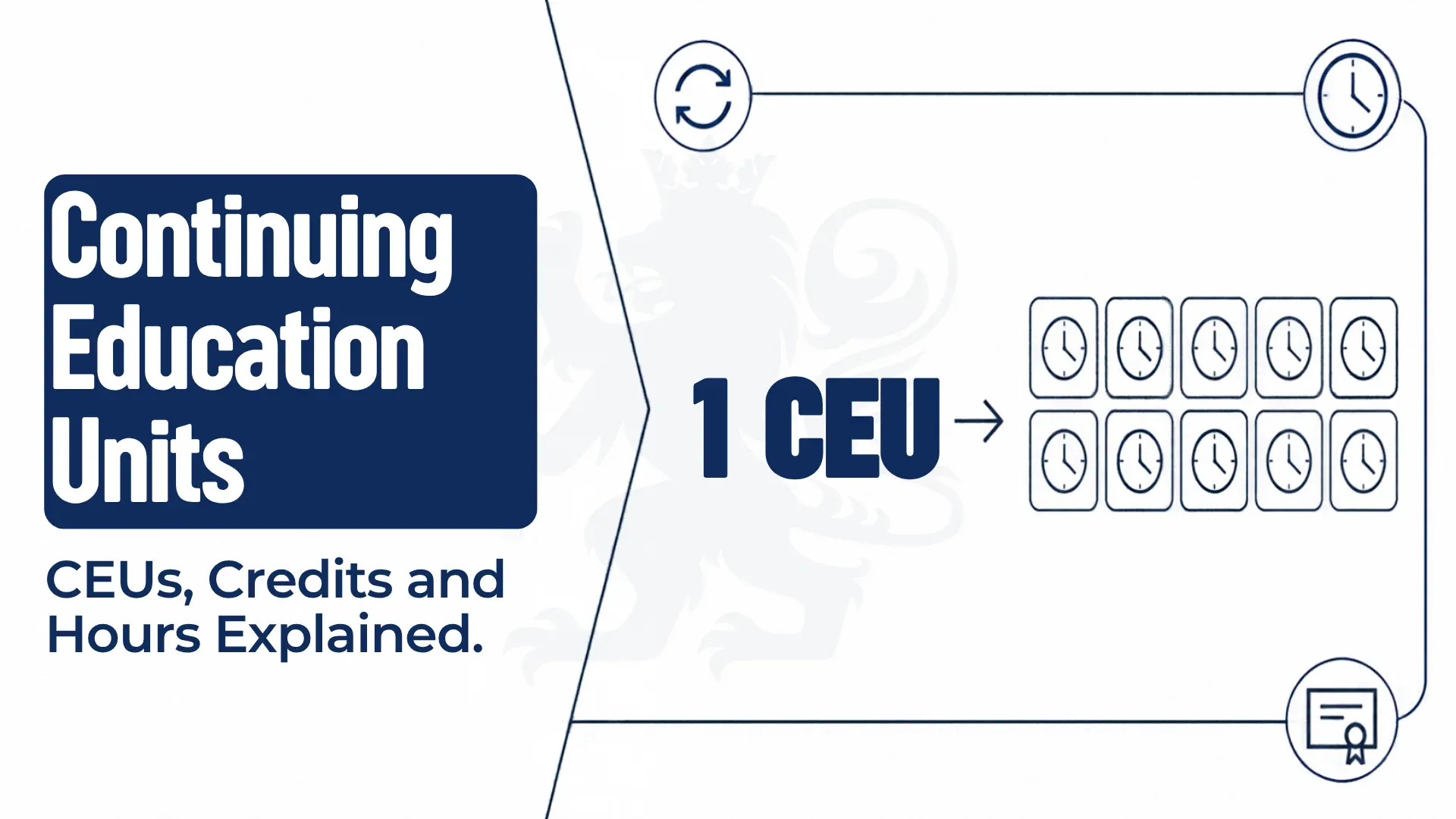
Continuing Education Units, commonly called CEUs, measure participation in organised professional and adult learning. You may encounter them when completing a training course, maintaining a professional certification or meeting continuing education requirements.
Under the widely used CEU definition, one CEU represents 10 eligible contact hours. For example, a five-hour course may provide 0.5 CEU when the learning meets the applicable requirements.
CEUs help document continuing education, but they are not the same as academic credits or professional qualifications. Whether a course’s CEUs count towards your requirements depends on the organisation receiving your record.
What Are Continuing Education Units?
Continuing Education Units record participation in structured adult and professional learning. They are commonly associated with non-credit courses, workplace training, professional programmes and certification maintenance.
Put simply, a CEU converts eligible learning time into a standard unit. Ten recognised contact hours produce one full CEU under the commonly used definition. Shorter programmes may receive a fraction of a unit where the applicable framework permits it.
The activity should have a genuine educational purpose. It will normally include planned content, learning outcomes, suitable instruction and a way to confirm that the learner completed the required work. Attending a general meeting or event without an identifiable learning component does not automatically justify a CEU award.
Official Head Start guidance on Continuing Education Units reflects the established definition that one CEU represents 10 contact hours of participation in organised continuing education or training. Individual professional organisations may still apply their own provider, recognition and reporting requirements.
What Does CEU Stand For?
CEU stands for Continuing Education Unit. The plural is Continuing Education Units, abbreviated as CEUs. The term is used across adult education, professional training and some licensing or certification systems.
The word “unit” is important because one CEU does not normally mean one learning hour. Under the common calculation, a single eligible contact hour represents 0.1 CEU.
Confusion arises because some providers and professional organisations use “CEU” informally to describe any continuing education credit. A requirement for “10 CEUs” could therefore be interpreted very differently depending on the organisation that issued it.
Learners should confirm whether a stated requirement refers to full Continuing Education Units, individual contact hours or another form of continuing education credit. The number should always be read together with the system behind it.
What Are CEU Credits?
CEU credits are numerical records of continuing education completed under a particular credit system. A certificate may show 0.3 CEU, 0.5 CEU or another amount calculated from the course’s eligible contact time.
The wider phrase “continuing education credit” does not always mean a formal CEU. Some professions award one CE credit for every contact hour. Under that system, a five-hour course might provide five CE credits, while the formal CEU calculation would produce 0.5 CEU.
Both figures can be correct within their respective systems. The problem occurs when a provider states only “five credits” or “five CEUs” without identifying the measurement used.
Course information should state the contact hours and label the units clearly. Learners should avoid converting credits independently unless the receiving organisation has published a conversion rule.
How Do Continuing Education Units Work?
A continuing education provider creates a structured learning activity and identifies its eligible contact time. The learner completes the required teaching, activities or assessment, after which the provider issues a certificate or learning record.
The learner may use that record when reporting professional development to an employer, certification organisation, professional association or licensing authority. The receiving organisation then decides whether the provider, subject and delivery method satisfy its requirements.
This involves two separate decisions. The provider confirms that the learner completed the education and calculates the units. The receiving organisation decides whether that education can be used towards the learner’s professional requirement.
A CEU certificate therefore provides evidence of completed learning without guaranteeing universal recognition. The provider’s claims should remain within the scope of the framework supporting the units.
CEU Credits vs CEU Hours
CEU credits and CEU hours describe related parts of a continuing education calculation. Contact hours measure eligible learning time, while CEUs are the units calculated from that time.
A contact hour may include instructor-led teaching, structured online learning, guided discussion, practical activities or assessment. Registration, breaks, meals and unrelated networking should not normally be included because they do not contribute to the learning outcomes.
The phrase “CEU hours” is often used informally, but it can be unclear. Providers should state both the eligible contact hours and the resulting CEUs wherever possible.
For example, a certificate might state:
Eligible learning time: 6 contact hours
Continuing Education Units awarded: 0.6 CEU
This wording shows the learner and receiving organisation exactly what the credit represents.
How Are CEU Credits Calculated?
Under the commonly used CEU calculation:
Eligible contact hours ÷ 10 = CEUs
For example, a seven-hour workshop includes a 30-minute break, leaving 6.5 eligible contact hours. Dividing 6.5 by 10 gives an unrounded result of 0.65 CEU.
The number actually awarded must follow the applicable framework’s precision and rounding rules. One framework may permit hundredths, while another may require credits to be recorded in tenths or another specified increment.
Providers should calculate eligible contact time accurately, exclude non-educational activities and confirm the required precision before issuing CEUs. They should not round a value simply because it produces a more attractive credit claim.
For online learning, the calculation should reflect meaningful activity rather than video duration alone. Required reading, exercises and assessment may contribute when they form part of the structured learning experience.
What Are Continuing Education Hours?
Continuing education hours describe time spent completing eligible learning after initial education or professional training. They may also be called CE hours, contact hours, instructional hours or training hours, depending on the system.
Under the commonly used CEU calculation, a contact hour represents 60 minutes of eligible learning activity. This may include instructor-led teaching, structured online learning and other approved activities supporting the intended learning outcomes.
Other professional credit systems may define instructional time differently. Learners should check which system applies before converting contact hours into CEUs, CPD points or another type of credit.
The guide on how many hours of continuing education explains professional requirements, reporting periods and qualifying activities in greater detail.
What Is a CEU Course?
A CEU course is an organised learning activity through which eligible Continuing Education Units can be awarded. It may be delivered in person, live online or through a structured self-paced platform.
A credible course should identify its intended learners, learning outcomes, content, educator and completion requirements. It should state the eligible contact hours and explain which credit system is being used.
The title “CEU course” does not prove that every licensing authority or professional organisation will accept it. Learners should check who issued or approved the credits and whether that provider is recognised under their professional framework.
The terms CEU course, CEU class and CEU training are often used for similar activities. Course structure and recognition matter more than the marketing phrase selected.
What Is a CEU Certificate?
A CEU certificate records a learner’s completion of a continuing education activity. It may support licence renewal, certification maintenance, employment requirements or a voluntary professional-development record.
A useful certificate identifies the learner, course, provider, completion date, contact hours and CEUs awarded. It may also show the delivery method, assessment result and approval or provider reference.
A CEU certificate is not the same as professional certification. The certificate confirms completion of a learning activity, while professional certification normally involves a broader assessment against occupational or professional standards.
Providers should avoid implying that a short course grants a licence, regulated qualification or professional status. Certificate wording should describe exactly what the learner completed and what credits were awarded.
What Are CEU Credits Good For?
CEU credits help learners document continuing education. Depending on the applicable framework, they may support licence renewal, certification maintenance, professional membership, workplace requirements or voluntary development.
A CEU record can show that a learner completed structured education in a particular subject. It also identifies the amount of eligible learning recorded under the course’s credit system.
CEUs do not guarantee promotion, employment or renewal. The receiving organisation may consider the provider, subject, completion date and relationship to the learner’s professional responsibilities.
Learners should choose education that addresses a genuine professional need. The credit total provides a record, while the practical value comes from what the learner understands and applies.
CEU Credits vs CPD Points
CEU credits and CPD points both record professional learning, but there is no universal conversion between them.
A ten-hour course may equal one CEU under the established CEU calculation. The same course might provide 10 CPD points under a scheme awarding one point per learning hour. Another professional body could use a different calculation.
Learners should use the unit required by the organisation receiving their record. Providers may state approved learning time and credits but should not guarantee how an unrelated professional body will convert them.
The central CPD points guide explains CPD credits, hours, calculations and professional-development records.
Are CEUs Academic Credits?
CEUs are generally associated with non-credit professional and adult learning. Academic credits normally form part of a degree, diploma or other formal programme. The two should not be treated as automatically transferable.
A CEU course can still be detailed, assessed and professionally valuable. Non-credit status describes the recognition system and does not mean that the course lacks educational value.
A university or awarding institution may decide to recognise previous learning under its own policies. A CEU certificate does not require an institution to award academic credit.
Learners seeking entry or credit towards a formal programme should contact the receiving institution before enrolling in a CEU course for that purpose.
Continuing Education Unit Accreditation
CEU accreditation or approval may involve reviewing a provider, an individual course or both. The process can examine the educational need, learning outcomes, content, educator competence, contact-hour calculation and learner records.
Requirements vary by profession and jurisdiction. Some systems require formal provider approval before credits can be advertised. Others publish eligibility criteria and place responsibility on the provider or learner to demonstrate compliance.
At CPD Qualifications, individual professional development courses are independently assessed for CPD accreditation. The review considers learning outcomes, course materials, delivery structure and the claimed CPD learning hours.
CPD accreditation should not be confused with accreditation under a separate CEU framework. Approval by CPD Qualifications does not automatically authorise a provider to issue CEUs under another accreditation system or guarantee acceptance by a professional licensing body.
Training providers should clearly state which accreditation they hold, the approved scope of their course and the learning hours or credits supported by that approval.
How to Offer Continuing Education Credits
A provider seeking to offer recognised continuing education credits should begin with the organisation expected to recognise them. The provider needs to know which profession it is serving, whether approval is required and what educational standards apply.
The course should then be designed around a clear learning need. It needs measurable outcomes, suitable content, qualified instruction, a defensible duration and a reliable method of confirming completion.
Detailed provider procedures belong to the guide on how to offer CEU credits. That article covers provider approval, course development, credit allocation, certificates and quality assurance.
Providers should not advertise recognised credits while approval remains pending. Any marketing claim should match the scope of the approval actually held.
Who Can Provide Recognised CEU Credits?
Universities, colleges, professional associations, employers, public bodies and commercial training organisations may be able to provide CEU credits. Independent educators may also qualify within some systems.
Eligibility depends on the receiving framework. Some organisations are automatically accepted, while others must apply for provider status or submit each course for approval.
Being qualified to teach a subject does not automatically grant authority to issue credits recognised by every profession. Instructor competence and provider approval are separate considerations.
Approval for one course, profession or jurisdiction should not be presented as universal authority. Providers should state who recognises the learning and which audience the credit is intended to support.
CEU Requirements and Recognition
Recognition depends on more than the number printed on a certificate. A professional organisation may examine the provider, course subject, delivery method, completion date and relationship to the learner’s work.
Some requirements specify mandatory subjects or limits on online and self-directed learning. A learner may complete the correct number of hours but still fall short if the education does not meet those conditions.
Before enrolling, check who approved or issued the credits and whether the activity fits the relevant reporting period. Confirm what the certificate will contain and whether a provider number or specific wording is required.
Requirements can change between renewal cycles. Acceptance during a previous period does not guarantee that the same course or provider will remain eligible.
Common Misunderstandings About CEUs
One common misunderstanding is that one CEU equals one hour. Under the widely used calculation, a full unit represents 10 eligible contact hours.
Another misunderstanding is that CEUs and CE credits always mean the same thing. Some systems award one credit per contact hour, while a formal CEU represents a larger unit. The measurement should be identified clearly.
A completion certificate is also sometimes mistaken for professional certification. One records a learning activity, while the other may represent a broader assessment of professional capability.
Accreditation can also be misunderstood as universal recognition. Approval confirms that a provider or course has met a particular framework. Other professional organisations remain free to apply their own rules.
How to Check Whether a CEU Course Is Accepted
Begin by identifying the organisation that requires your continuing education. Review its current guidance before selecting a course.
Check the provider, subject, contact hours, delivery method and credit calculation. Confirm whether online learning is accepted and whether the course falls within the correct reporting period.
Keep the course description and completion certificate. A receiving organisation may ask for information beyond the total units, particularly during an audit.
If the rules are unclear, contact the organisation directly. Confirmation obtained before enrolment is more useful than discovering after completion that the education cannot be claimed.
Summary
Continuing Education Units measure participation in organised continuing education. Under the widely used definition, one CEU equals 10 eligible contact hours. The final award should follow the precision and rounding rules of the applicable framework.
CEU credits, contact hours, CPD points and academic credits are different measurements. Their value and recognition depend on the provider, course and organisation receiving the learner’s record.
A CEU certificate supports a continuing education claim but does not automatically establish professional certification, competence or academic credit. Learners should confirm acceptance before enrolling, and providers should advertise only the credits they have a valid basis to issue.
Frequently asked questions
What is the definition of Continuing Education Units?
Continuing Education Units measure participation in organised continuing education or training. Under the widely used conversion, one CEU equals 10 contact hours. The receiving organisation determines whether the units satisfy its requirements.
What does Continuing Education Units mean?
The term refers to numerical units used to record non-credit continuing education. CEUs help document the amount of eligible learning a person has completed. They do not automatically represent academic credit or professional competence.
What does CEU stand for in education?
CEU stands for Continuing Education Unit. CEUs are used in adult education, professional training and some licensing or certification systems. The exact recognition rules depend on the applicable framework.
What are CEUs in education?
CEUs are measures of participation in organised continuing education. They are commonly used for professional learning completed after initial education or training. They usually relate to non-credit learning rather than academic degree credits.
What are CEU credits?
CEU credits are units recorded for eligible continuing education. Under the common formal model, 10 contact hours equal one CEU. Some organisations use the term “CE credit” differently, so the calculation should always be checked.
What is the meaning of CEU credits?
CEU credits show the amount of recognised continuing education attached to an activity. Their practical value depends on the provider and receiving organisation. A stated amount does not guarantee acceptance by every professional body.
What is the difference between CEU credits and CEU hours?
A contact hour measures eligible participation time, while a CEU is calculated from that time. Under the common conversion, one contact hour equals 0.1 CEU. Some frameworks use different terminology or rules.
What are continuing education hours?
Continuing education hours are hours spent completing eligible learning after initial training or education. They may include instruction, guided activity, practice and assessment. The relevant organisation decides what time qualifies.
What is a CEU course?
A CEU course is a continuing education activity that awards units based on an applicable CEU framework. It should have defined learning outcomes, eligible contact time and completion requirements. Recognition should be checked before enrolment.
What are CEU classes?
CEU classes are organised learning activities through which participants may earn Continuing Education Units. They can be delivered in person, online or through another structured format. Their acceptance depends on the applicable professional requirements.
What is CEU training?
CEU training is professional or adult learning measured through Continuing Education Units. It may help a learner maintain knowledge, develop skills or work towards a renewal requirement. The provider and credit system should be identified clearly.
What is a CEU certificate?
A CEU certificate records a learner’s completion of a continuing education activity. It may show the course title, date, contact hours and units awarded. It is evidence of learning rather than automatic professional certification.
What are CEU credits good for?
CEU credits may support licence renewal, certification maintenance, employment requirements or voluntary professional development. Their use depends on whether the receiving organisation recognises the provider and activity. Learners should confirm acceptance before relying on them.
How do you offer continuing education credits?
A provider must identify the applicable framework, design suitable learning, calculate contact hours and maintain completion records. Provider approval may also be required. Credits should not be advertised until the provider has established a valid basis for issuing them.
How do you provide CEU credits?
CEU credits should be provided through an organised learning programme with clear outcomes, eligible contact time and reliable records. The provider must follow the requirements of the approving or receiving organisation. An accurate certificate should identify the units and calculation.
What is Continuing Education Unit accreditation?
Continuing Education Unit accreditation or approval is a process for reviewing a provider or educational activity against defined standards. It may examine course design, learning time, educator competence and record keeping. Approval does not guarantee recognition by every profession.
Are CEU credits the same as CPD points?
No universal conversion exists between CEU credits and CPD points. Under one framework, a 10-hour course may equal one CEU and 10 CPD points, but another scheme may calculate the result differently. The organisation receiving the record determines the accepted conversion.