

Offering CEU credits involves more than developing a course and printing a credit value on its certificate. Training providers must first establish which continuing education framework applies to their intended learners and what that framework permits them to claim.
Some systems require organisational accreditation. Others assess individual courses, recognise providers that meet published criteria or accept learning from particular education partners. A training organisation can issue its own course-completion record, but that does not automatically make the learning recognised CEU education.
Before advertising recognised credits, providers should confirm that they meet the relevant requirements and hold any approval or authorisation that the framework requires. They should also explain which organisation or system recognises the credits rather than implying universal acceptance.
What Are CEU Credits?
A Continuing Education Unit is a measure used within certain systems to record participation in organised, non-degree professional education. Continuing education credits may support certification maintenance, licence renewal or ongoing development requirements where they are accepted by the relevant organisation.
However, completing CEU-bearing education does not automatically demonstrate professional competence. A credit may show that a person completed a defined learning activity, but competence can also depend on assessment results, practical performance, workplace evidence and the standards of the profession.
Under the commonly used ten-hour model, one CEU represents 10 eligible contact hours. Not every organisation uses this model. Some award continuing education credits hour for hour, while others use CPD hours, professional development units, points or their own measurements.
A three-hour course therefore does not automatically award three CEUs. Under the ten-contact-hour calculation, three eligible hours would equal 0.3 CEU. Under another framework, the same course could be recorded as three continuing education hours or three CPD hours.
Our guide to the definition of Continuing Education Units explains these measurements from the learner’s perspective. This guide concentrates on how providers can design, approve and document eligible training.
Can Any Training Provider Offer CEU Credits?
Training companies, education institutions, professional associations, government units and corporate learning departments may be able to offer CEU credits. Their ability to issue recognised credits depends on the particular framework under which they operate.
Any organisation can describe the duration of its training and issue an accurate completion certificate. It cannot assume that this record will be accepted as recognised CEU credit by a professional body, licensing board or accreditation system.
For example, organisations applying for IACET Accredited Provider status must meet defined eligibility conditions. According to the organisation’s current guidance, eligible applicants include incorporated or chartered organisations, governmental units and legally recognised sole proprietorships. Applicants must also have operated under the relevant conditions for at least one year.
IACET assesses an organisation’s continuing education and training systems rather than approving an isolated course submitted independently. Once accredited, the provider remains responsible for ensuring that every learning activity for which it awards IACET CEUs meets the applicable requirements. Current eligibility and application information is available through the IACET Accredited Provider guidance.
Providers pursuing another recognition system should read that system’s own eligibility rules. The IACET model should not be treated as the universal process for every profession or country.
The Difference Between Completion, Credit and Recognition
Three separate ideas are often combined when providers discuss continuing ed credits.
A completion record confirms that a learner finished an activity. It may show the title, date and duration without claiming recognition from an external organisation.
A credit value expresses the learning according to a defined calculation. For example, an approved system may convert 10 eligible contact hours into one CEU.
Recognition means that a regulator, professional body, licensing board, certification organisation or accrediting body accepts that credit for a stated purpose. Recognition may be limited to particular professions, subjects, jurisdictions or renewal cycles.
A provider can control whether its own records are accurate. It cannot independently guarantee how every external organisation will treat them. Marketing and certificates should preserve this distinction.
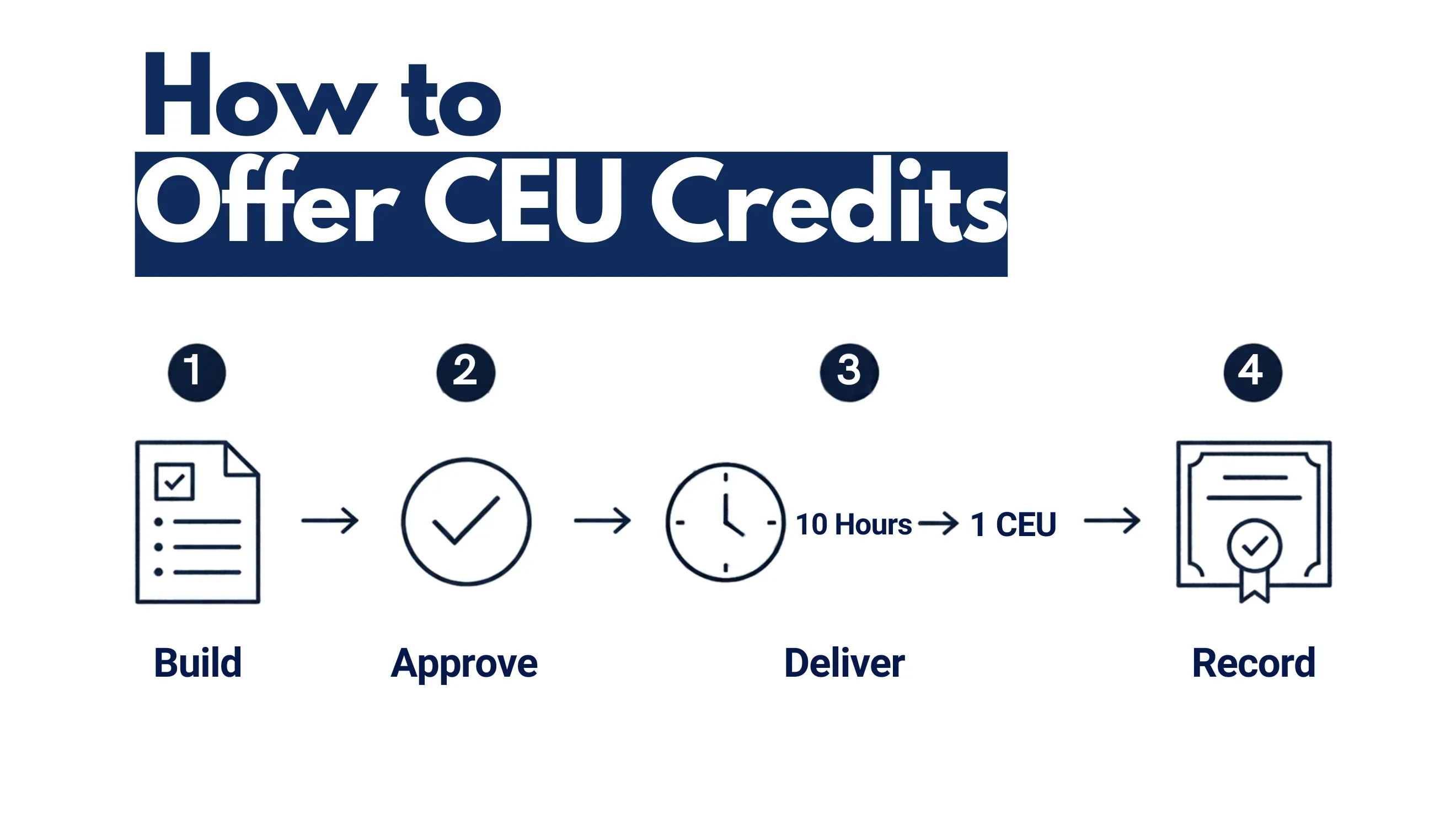
How to Offer CEU Credits
The correct process begins with the intended professional audience rather than the course certificate. Providers need to identify who will take the course, why they need continuing education and which organisation decides what will be accepted.
A practical process is:
- Define the target profession and jurisdiction.
- Identify the relevant regulator, licensing board or certification organisation.
- Review its current provider and course requirements.
- Select organisational accreditation, course approval or another permitted recognition route.
- Develop the course and its supporting documents.
- Establish assessment, attendance and record-keeping procedures.
- Submit the required application or evidence.
- Obtain any necessary approval before making recognition claims.
- Deliver the training under the approved conditions.
- Verify completion and issue accurate documentation.
- Retain records and review the programme regularly.
This order reduces avoidable rework. A provider that finishes its course before reading the applicable rules may later discover that its learning outcomes, assessment, delivery method or attendance controls do not meet the required standard.
An application, payment or pending review is not evidence of approval. Training should not be advertised as accredited or officially recognised until the decision has been confirmed and the provider understands the scope of that recognition.
Choose the Correct CEU Recognition Route
There is no single CEU approval process for every provider. The suitable route depends on the profession, jurisdiction, recognition framework and intended use of the credits.
Organisational accreditation
Under this route, an accreditation body examines the organisation’s continuing education systems. The assessment may consider governance, course development, instructional personnel, learner support, assessment, evaluation, credit calculation and record management.
Organisational accreditation does not mean that anything the provider delivers automatically becomes eligible. The provider remains responsible for applying the approved system to each learning event for which it awards recognised credits.
Individual course approval
Some licensing boards, regulators and professional associations review courses individually. A provider may need to submit the course content, instructor qualifications, learning outcomes, duration, assessment and delivery method before offering recognised credits.
Approval may apply only to the version, audience, delivery period or subject reviewed. Material changes can require notification or another assessment.
Recognition through published criteria
Some organisations do not operate a conventional accreditation application for every provider or course. Instead, they publish criteria describing acceptable subjects, instructors, evidence, learning formats or provider types.
In this situation, providers must determine whether they genuinely meet the criteria and describe the credits carefully. The receiving professional organisation still makes the final acceptance decision.
Collaboration with an approved provider
A smaller training organisation may be able to collaborate with an approved continuing education provider, subject to the applicable accreditation rules.
Where this is permitted, the approved provider must retain the responsibility, oversight and control required by its framework. A partnership does not automatically allow an unapproved organisation to issue recognised CEUs independently or use another provider’s accreditation number, certificate wording or logo.
The responsibilities of both organisations should be documented before the training is advertised or delivered. The agreement should establish who controls the programme, reviews the course, verifies completion, retains records and issues the official credits.
Accreditation cannot simply be lent to another business as a marketing asset.
Requirements for Offering CEU Credits
Although specific requirements vary, credible continuing education systems generally examine similar educational and administrative areas.
The provider should have a clear organisational structure and assign responsibility for continuing education. Someone must oversee course development, instructor selection, assessment, attendance, certificates, learner records, complaints and quality assurance.
Every programme should address an identifiable educational need. The need might arise from changes in professional regulation, employer feedback, industry research, learner consultation or evidence of a skills gap.
Providers also need measurable learning outcomes. “Understand health and safety” is too broad to assess reliably. A stronger outcome would be: “By the end of the course, participants will be able to identify five common workplace hazards and select an appropriate control measure for each.”
The content, teaching method and assessment should connect directly to those outcomes. If an outcome requires a learner to demonstrate a practical skill, a basic multiple-choice quiz may not provide sufficient evidence.
Other requirements may include qualified instructors, suitable learning materials, accessible delivery, defined completion criteria, verified attendance, course evaluation and secure record-keeping. Providers should also maintain policies for complaints, certificate corrections, data protection and conflicts of interest.
How to Become an Approved CEU Provider
Start by identifying the organisation whose recognition matters to your intended learners. Approval that their professional body does not accept may offer little practical value.
Read the current eligibility and evidence requirements before paying for an application or preparing extensive documentation. Eligibility, charges, review periods and renewal conditions can change.
Conduct a gap analysis comparing your current operation with each applicable requirement. A training company may already have strong content and instructors but lack documented processes for attendance verification, assessment security, certificate amendments or long-term learner records.
Your policies should reflect what happens in practice. Reviewers may request evidence that procedures are actively used, such as completed evaluations, course files, assessment records, instructor agreements and sample certificates.
Once submitted, an application may involve document review, questions, an interview or another form of assessment. Respond with specific evidence rather than broad claims about training quality.
Approval is not necessarily permanent. Providers may need to submit reports, complete periodic reviews, renew their status and notify the approving organisation when significant operational changes occur.
How to Develop a CEU-Eligible Course
Begin with a genuine learning need. Consult employers, professionals, subject specialists and prospective learners to understand the difference between current performance and the knowledge or skill required.
Define the intended audience and any entry requirements. A specialist programme for experienced practitioners should not rely on the same content, language or assessment as an introductory course.
Write the learning outcomes before preparing the lessons. Each outcome should describe something the learner will be able to explain, apply, analyse or demonstrate after completing the activity.
A complete course file can include:
- The identified professional learning need
- Intended audience and prerequisites
- Measurable learning outcomes
- Course syllabus and timed agenda
- Instructor qualifications
- Learning materials and references
- Delivery and participation methods
- Assessment and completion criteria
- Eligible contact-hour calculation
- Evaluation procedures
- Accessibility and learner-support arrangements
Breaks, meals, registration and commercial presentations should remain separate from eligible instructional time. A longer event does not automatically create a larger legitimate credit award.
Assessments and Completion Criteria
Attendance does not always prove that a learner achieved the stated outcomes. Providers should select assessment methods that match the learning being claimed.
A knowledge-based course may use a quiz, written exercise or case analysis. Practical education might require an observed demonstration, simulation or assessed work product. Communication training could use a scenario, presentation or reflective exercise.
Completion criteria must be established before delivery and communicated clearly. Requirements could include minimum attendance, completion of all modules, participation in specified activities and a stated assessment result.
If a learner does not meet the criteria, the provider needs a consistent response. Reassessment or completion of a missed component may be permitted, but recognised credit should not be awarded simply because the learner paid for the course or attended part of it.
How Are CEU Credits Calculated?
Under the widely used ten-contact-hour model:
1 eligible contact hour equals 0.1 CEU.
5 eligible contact hours equal 0.5 CEU.
10 eligible contact hours equal 1 CEU.
15 eligible contact hours equal 1.5 CEUs.
The US government’s Head Start professional development guidance describes one CEU as 10 contact hours of participation in an organised continuing education or training experience.
Only eligible learning time should enter the calculation. Registration, meals, breaks, social activities and unrelated business sessions are generally excluded. Providers must also follow the minimum-duration, precision and rounding rules of the framework under which they operate.
Suppose a programme runs from 9:00 am until 4:30 pm. It includes a 30-minute lunch, two 15-minute breaks and 30 minutes for registration and announcements. Although the event occupies seven and a half hours, it contains six eligible instructional hours. Under the ten-hour model, that would calculate to 0.6 CEU.
The arithmetic does not create recognition by itself. A provider still needs the authority required by the relevant framework before advertising the result as recognised CEU credit.
For more detail on contact hours, visit our guide to continuing education hours.
A Practical Example: A Workplace Safety Training Company
Consider a hypothetical training company that develops workplace safety courses for professionals across several industries.
Before advertising continuing education credits, the company identifies the occupations it wants to serve. It checks the requirements of the licensing boards, certification organisations and professional associations relevant to those learners.
The research shows that one organisation accepts education from providers meeting published criteria, while another requires individual courses to be approved. A third profession allows relevant CPD but does not guarantee credit based solely on an external certificate.
The company documents its learning needs, course outcomes, instructor qualifications, assessment procedures and eligible instructional hours. It prepares separate applications or supporting information for the recognition routes it intends to use.
Only after satisfying the applicable requirements and receiving any necessary authorisation does it advertise recognised credits. Its course page states which framework applies and advises learners to confirm acceptance with their own professional organisation.
This example demonstrates why the provider should begin with the intended audience. One course may be educationally relevant to several professions but receive different recognition in each system.
Offering CEU Credits for Online Courses
Online courses can support recognised continuing education when they meet the same relevant educational and quality requirements as other formats.
A live webinar might use attendance reports, identity checks, participation activities and timed assessments. A self-paced programme could use secure individual accounts, module tracking, knowledge checks and a final assessment.
Time connected to a learning platform should not automatically be counted as instructional time. A browser can remain open while the learner is inactive. Credit should be based on an approved course calculation and verified completion rather than unexamined login data.
Providers should also plan for accessibility, technical failure, assessment integrity and learner support. Their procedures should explain what happens when someone loses connection, cannot access essential materials or experiences a technical error during an assessment.
How to Issue CEU Certificates
A certificate should be issued only after the learner has met all established completion criteria. It needs to identify clearly what was completed and what measurement was awarded.
A suitable certificate generally includes:
- The learner’s full name
- The provider’s recognised or legal name
- The course title
- The completion date
- The number and type of credits awarded
- Eligible contact hours where applicable
- A certificate or record number
- An authorised signature or approval
- The provider or course approval reference, where permitted
The wording should distinguish CEUs, contact hours, continuing education credits and CPD hours. The expression “10 CEU hours” is unclear because an hour and a CEU are different measurements. Where properly authorised, “10 contact hours / 1.0 CEU” is more precise.
Do not display an accreditor’s logo, quality mark or approval number unless the provider has explicit permission and complies with its usage rules. The certificate must not imply recognition beyond the scope actually granted.
Maintaining Learner and Course Records
The certificate is only the learner-facing part of the evidence. Providers need an internal record showing how and why the credit was awarded.
A learner record may include identity information, the course version, completion date, attendance evidence, assessment result, awarded credits and certificate number. The record should connect to the approved course agenda and credit calculation.
Set a retention period that complies with the relevant recognition framework and applicable law. Protect records against unauthorised access, accidental loss and inappropriate alteration while keeping them retrievable for legitimate certificate or transcript requests.
Providers should also establish a controlled correction process. If a name, date or credit value is wrong, the amendment should remain traceable, and the incorrect certificate should be replaced without creating unexplained duplicate records.
How Learners Get CEU Credits
Learners obtain CEU credits by completing an eligible course and meeting its participation and assessment requirements. Registration or partial attendance may not be enough.
Someone looking for continuing ed credits should first confirm which providers, subjects and learning formats their professional organisation accepts. After completing the course, the learner may need to submit the certificate or transcript through a separate renewal or reporting process.
The provider decides whether the learner satisfied its course requirements. The regulator, licensing board or professional body decides whether the resulting record fulfils its own requirements.
Providers should communicate that limitation before enrolment. They should never promise that a course will satisfy every learner’s licence or certification requirements.
CEU Accreditation vs CPD Accreditation
CEU and CPD frameworks both concern continuing professional learning, but their approval processes and measurements can differ.
A CEU framework may use 10 contact hours as one unit and require particular systems for programme development, assessment and records. A CPD framework might recognise active learning hours, points or another measurement and could place additional emphasis on relevance, reflection and outcomes.
Approval under one system does not automatically authorise a provider to claim recognition under the other.
At CPD Qualifications, individual professional development courses are independently reviewed for CPD accreditation. The assessment examines the submitted learning activity, including its outcomes, materials, delivery structure, assessment or completion evidence and claimed active CPD hours.
Provider Approval is a separate assessment of the training organisation and its operating processes. It does not mean that every course in the provider’s catalogue is CPD accredited. Each named course requiring approved CPD wording or course accreditation must be assessed under its own scope.
Neither Provider Approval nor individual course accreditation from CPD Qualifications authorises an organisation to issue IACET CEUs. It also does not guarantee that a licensing authority, regulator or professional body will accept a course for renewal.
Training organisations can learn more about CPD course accreditation and the evidence considered during the CPD review process.
For an explanation of points, credits and hours, read our CPD points guide.
How Providers Can Maintain CEU Standards
Quality assurance should continue after initial approval. Review learner performance, course evaluations, complaints and instructor feedback to identify necessary improvements.
Evaluation should examine more than learner satisfaction. It should consider whether the content was relevant, the instructional methods supported the outcomes and learners could apply what they learned.
Update the course when professional practice, regulations or technical evidence changes. Assign responsibility for reviewing revisions so that outdated material does not enter delivery without oversight.
Instructor monitoring is equally important. Subject knowledge alone does not guarantee effective teaching or fair assessment. New instructors may need orientation, observation and feedback before delivering an established programme independently.
Periodic internal reviews should compare the timetable with the advertised credits, check certificate accuracy and confirm that learner records are complete.
Common Mistakes When Offering CEU Credits
The most serious mistake is claiming recognised CEU status without establishing the applicable authority. A professional-looking certificate does not create external recognition.
Another common error is confusing contact hours with CEUs. Under the ten-hour model, a ten-hour course produces one CEU, not ten CEUs.
Providers can also make mistakes by using vague learning outcomes, relying entirely on attendance, including breaks in the credit total or failing to retain assessment evidence. Others use an approval number or logo outside its authorised scope.
A partnership with an approved provider is another area of risk. The approved organisation must retain the control required by its framework; its accreditation cannot simply be transferred to an independent course provider.
Finally, providers should not describe accreditation as a guarantee of licence renewal, professional competence or universal acceptance. Every claim should remain within the verified scope of the relevant approval.
Summary
A training organisation may issue an accurate record of its own course, but offering CEU credits recognised within a professional or accreditation framework requires closer attention to that framework’s rules.
Some systems accredit training organisations, some approve individual courses and others accept learning that meets published criteria. Where a provider partnership is permitted, the approved organisation must retain the responsibility and oversight required by its accreditation.
A strong programme begins with a genuine learning need and includes measurable outcomes, qualified instructors, suitable assessment, verified participation, accurate credit calculation and secure learner records. Under the widely used model, 10 eligible contact hours equal one CEU, but the calculation alone does not create recognised status.
Providers should describe their approval precisely, identify the applicable recognition system and remind learners that their own professional organisation makes the final acceptance decision.
Frequently asked questions
How do you offer CEU credits?
Identify the intended professional audience, establish which recognition framework applies, meet its educational and administrative requirements and obtain any required approval before advertising recognised credits.
Who can offer CEU credits?
Training companies, education institutions, professional associations, government units and corporate learning teams may be eligible. The applicable accreditation or professional framework determines who can issue its recognised credits.
Can any provider issue a completion certificate?
A provider can issue an accurate certificate recording its own training. It should not claim that the certificate carries recognised CEU credit unless that recognition has been properly established.
Can any training provider call its courses CEU accredited?
No. Accreditation claims must be supported by the relevant organisation and remain within the confirmed scope. A provider cannot create external recognition through its own marketing language.
How do you become an approved CEU provider?
Choose the relevant accreditation or professional organisation, check its eligibility criteria, compare your operation with its requirements and submit the necessary evidence for review.
Does IACET approve individual courses?
IACET accredits eligible organisations and their continuing education systems rather than independently approving isolated courses. Accredited Providers are responsible for applying the relevant requirements to the activities for which they award IACET CEUs.
Can an approved provider share its accreditation?
Approval cannot simply be lent or transferred. Where collaboration is permitted, the approved provider must retain the responsibility, oversight and control required by the applicable framework.
What are the requirements for offering CEU credits?
Common requirements include documented learning needs, measurable outcomes, qualified instructors, appropriate content, learner assessment, verified participation, course evaluation and reliable records.
How are CEU credits calculated?
Under the commonly used ten-contact-hour model, one CEU equals 10 eligible contact hours. Providers must follow the exact calculation and rounding rules of their recognition framework.
Can online courses offer CEU credits?
Yes, when the course satisfies the applicable requirements for structure, participation, assessment, eligible time and record-keeping.
What should a CEU certificate include?
It should identify the learner, provider, course, completion date and credit awarded. It may also require eligible contact hours, a certificate number and an authorised approval reference.
Is CEU accreditation the same as CPD accreditation?
No. The systems can use different approval requirements, measurements and terminology. Recognition under one does not automatically provide recognition under the other.
Does CPD Qualifications award IACET CEUs?
No. CPD Qualifications independently reviews professional development courses for CPD accreditation and assesses training organisations separately through Provider Approval. These services do not authorise providers to issue IACET CEUs.
Do CEU credits automatically count towards professional renewal?
No. The relevant licensing board, regulator or professional body decides whether a course and its credits satisfy its renewal requirements.